About Course
When a company runs out of money, the Insolvency and Bankruptcy Code, 2016 decides almost everything that follows: who can drag it into a process, who controls it while the process runs, who gets paid and in what order, and what a buyer takes free of. This course teaches that framework the way it is actually used, from the first demand notice to the last appeal.
It is built for creditors and business owners who need to know where they stand, and for law and commerce students and early practitioners who need working command of the Code rather than a reading list. Every lesson works through the section, the form or regulation that carries the detail, and a scenario drawn from the kind of facts that reach a Tribunal. The course also tracks the Insolvency and Bankruptcy Code (Amendment) Act, 2026, separating what came into force on 26 May 2026 from what is still waiting for a commencement notification and rules.
The six modules move in the order a real matter moves. Module 1 covers why the Code exists, how it is structured and the definitions and threshold that decide admission. Module 2 covers the three applications, the demand notice and the admission hearing. Module 3 covers the moratorium, the insolvency professional and the committee of creditors. Module 4 covers claims and verification, the resolution plan, and the timeline and waterfall of distribution. Module 5 covers liquidation, personal guarantors and the pre-packaged process for smaller enterprises. Module 6 covers appeals, cross-border and group insolvency, and the Supreme Court decisions that shaped the Code.
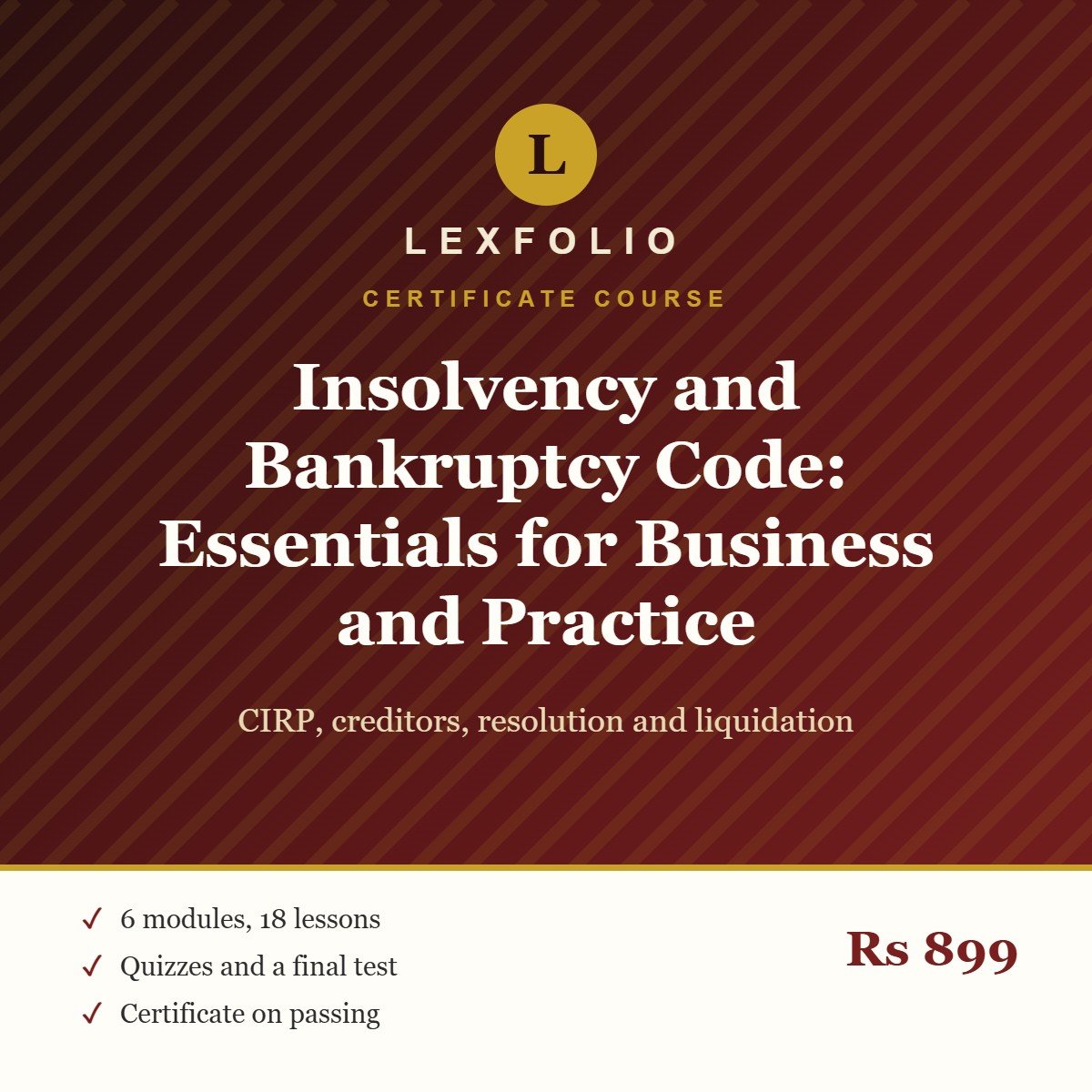
The format is 6 modules, 18 lessons, 6 module quizzes and a 30 question final test, with a pass mark of 60% and 3 attempts. On passing you receive a certificate, verifiable at lexfolio.in/verify-certificate/, and you keep lifetime access to the course and its updates.
What you will learn
- Tell financial debt from operational debt and apply the section 4 threshold correctly
- Prepare a section 7, 8, 9 or 10 filing in the right form with the right evidence
- Work out exactly what the moratorium under section 14 does and does not stop
- Read the committee’s voting thresholds and calculate who can carry a decision
- File and defend a proof of claim, and test a resolution plan against section 30(2)
- Apply the section 53 waterfall to work out a client’s realistic recovery
- Advise on personal guarantors, pre-packaged insolvency and liquidation
- Identify the appeal route, the restricted grounds and the unforgiving time limits
Who this course is for
- Lenders, suppliers and other creditors who need to know their rank and their options
- Business owners, promoters and directors facing or anticipating a default
- Law and commerce students, including those preparing for insolvency electives and interviews
- Early practitioners and company secretaries handling Tribunal work
- Finance, credit and recovery teams who deal with stressed accounts
Lexfolio is an independent education platform and is not affiliated with any court, government department or regulator. This course is general legal information, not legal advice.
Course Content
Why the Insolvency and Bankruptcy Code exists and how it is built
The Code in context: what it replaced and what it changed
The architecture of the Code: Parts, institutions and tracks
Debt, default and the threshold: who can file and who cannot
Module 1 quiz: the Code and its foundations
Starting a corporate insolvency: applications and admission
After admission: moratorium, professionals and the committee
Claims, resolution plans and distribution
Liquidation, personal guarantors and pre-packaged insolvency
Appeals, cross-border insolvency and the leading decisions
Final Assessment and Certificate
Student Ratings & Reviews

No Review Yet