About Course
A restaurant is never regulated as one business. The same kitchen is a food unit for the food authority, a trade for the municipal corporation, a workplace for the labour department, a place of public assembly for the fire service, a taxpayer for the tax department and a user of copyright for the music licensing bodies. This course gathers all of those obligations into one place for the people who actually carry them: owners, partners, general managers and operations heads of restaurants, cafes, bakeries, bars and delivery only cloud kitchens.
It solves the problems that cost food businesses the most money. Sealing because a trade licence was never taken or the sanctioned building use did not permit an eating house. A lease signed without a condition on permissions, leaving the fit out stranded. Revenue share computed on aggregator commission the restaurant never received. A default service charge that the consumer authority and the Delhi High Court have held cannot be levied. Unpaid overtime on a split shift with no attendance record to answer the claim. A hygiene file that stopped when the manager left. A promotion that lost money on every order because nobody read the discount funding split.
The six modules move in the order a real business meets them. Module 1 maps every licence and registration and the body that issues each one, with the food licence in outline because a separate course covers food licensing in depth. Module 2 covers premises due diligence, the lease clause by clause, and music, public performance rights and noise. Module 3 covers goods and services tax for restaurants and cloud kitchens, the bill, the service charge position and menu and packaged water pricing. Module 4 covers employment compliance under the four labour codes brought into force from 21 November 2025, together with social security, the sexual harassment law and the bar on employing children. Module 5 covers hygiene, pest control, staff medical records, inspections, sampling, penalties and the delivery aggregator relationship. Module 6 covers consumer complaints, food poisoning and foreign object claims, product liability, advertising and reviews, and a month wise compliance calendar.
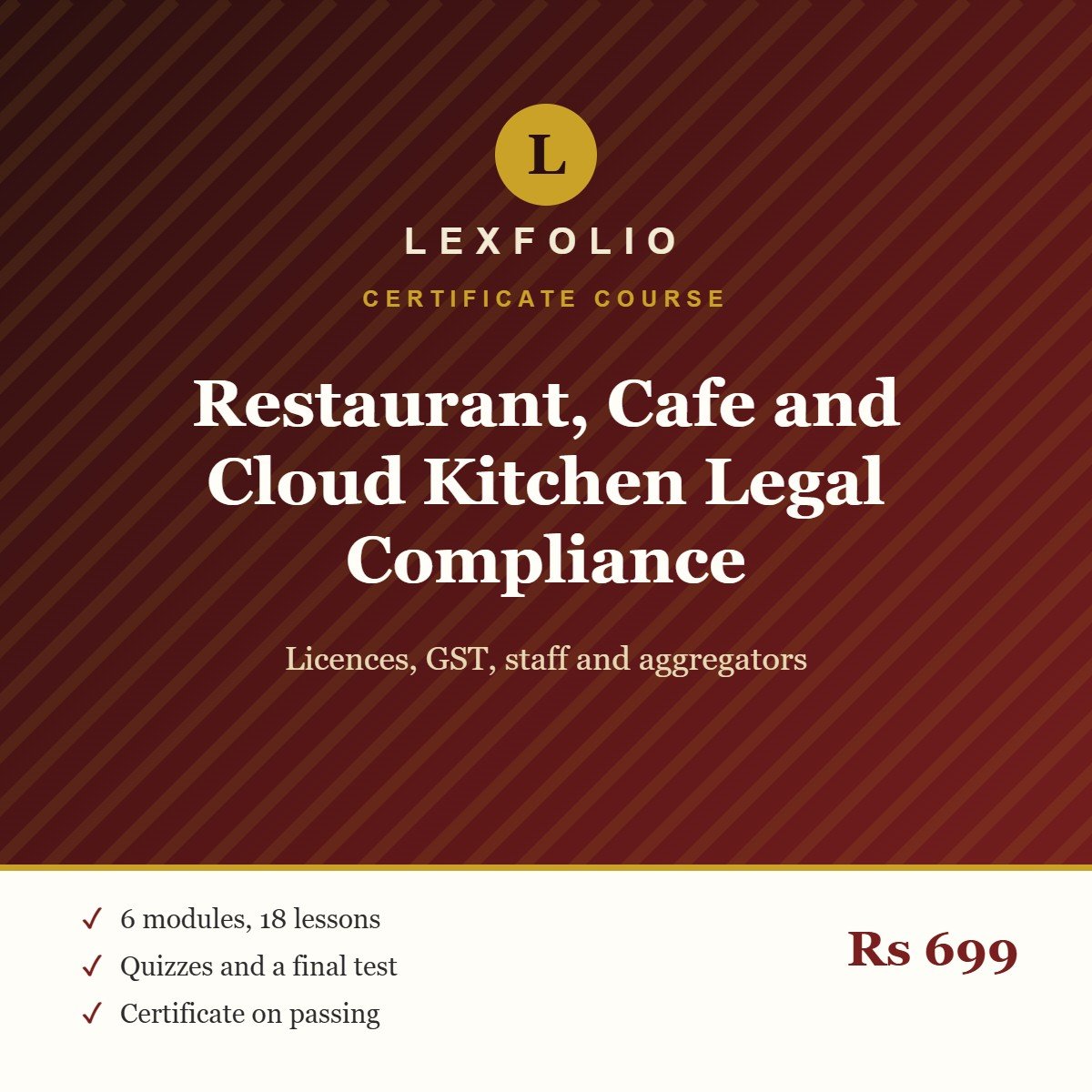
A great deal of this subject is state and municipal law, so figures and procedures are given as worked examples and the course teaches you how to confirm the current position for your own city. Format: 6 modules, 18 lessons, 6 module quizzes and a 30 question final test, with a pass mark of 60 per cent and 3 attempts. A certificate is issued on passing and can be verified at lexfolio.in/verify-certificate/. Access is for life.
What you will learn
- Identify every licence and registration your outlet needs and the body that grants each one
- Run a premises due diligence check and negotiate the lease clauses that actually protect a food business
- Apply the correct goods and services tax rate, including the specified premises test and aggregator supplies
- Build a compliant bill and handle the service charge position after the 2025 judgment
- Set up wages, hours, overtime, appointment letters and social security for kitchen and service staff
- Maintain the hygiene, pest control, medical and training records that an inspection turns on
- Read a delivery aggregator agreement for commission, discount funding, penalties and suspension risk
- Handle consumer complaints, foreign object and food poisoning claims, reviews and a month wise renewal calendar
Who this course is for
- Owners and partners opening a restaurant, cafe, bakery or bar
- Cloud kitchen founders and operators working through delivery platforms
- General managers, operations managers and outlet managers responsible for compliance
- Finance and human resources staff in food and beverage businesses
- Consultants, chartered accountants and company secretaries advising food businesses
- Law students and young advocates building a food and hospitality practice
Lexfolio is an independent education platform and is not affiliated with any court, government department or regulator. This course is general legal information, not legal advice.
Course Content
Module 1: Licences, registrations and who issues them
Lesson 1.1: Mapping your compliance universe before you sign a lease
Lesson 1.2: The food licence in outline, the trade licence and the eating house licence
Lesson 1.3: Fire safety, pollution consent, lift, signage and the outline of liquor licensing
Module 1 quiz: licences and registrations
Module 2: Premises, lease, landlord and the neighbourhood
Module 3: GST, billing, service charge and pricing
Module 4: Employing kitchen and service staff
Module 5: Hygiene, inspections and the aggregator relationship
Module 6: Consumer claims, reputation and the compliance calendar
Final Assessment and Certificate
Student Ratings & Reviews

No Review Yet