Description
Anti-money laundering work has moved from a banking back office subject to a mainstream compliance skill. The Prevention of Money-Laundering Act, 2002 and the rules under it now reach banks, non banking financial companies, payment firms, securities and insurance intermediaries, casinos, dealers in precious metals, real estate agents, virtual digital asset businesses, company and trust service providers, and practising chartered accountants, company secretaries and cost and works accountants who handle client money or client entities.
This course is built for the person who has to make the rules work: a compliance officer who must defend an alert closure, a branch or operations officer who has to ask a customer an awkward question, a fintech or payments team designing onboarding, a professional service firm that has just discovered it owes reporting duties, and a job seeker who needs to speak the language of the function with confidence. The emphasis throughout is on what to record, when to report and how to evidence a decision, because that is what an inspection tests.
The six modules move from concept to practice. Module one covers what money laundering is, the placement, layering and integration model, and the Indian legal and institutional map. Module two covers the offence under section 3, the punishment under section 4, the reverse burden under section 24, and the attachment, search, seizure, arrest and summons powers, along with adjudication, appeals and the Special Court structure including the twin bail conditions. Module three covers who is a reporting entity, the 2023 notifications that brought professionals and corporate service providers in, the record keeping duties under section 12, and the designated director and principal officer roles. Module four covers customer due diligence under rule 9, risk categorisation, periodic updation, ongoing monitoring, beneficial ownership tracing and politically exposed persons. Module five covers the report types with their thresholds and timelines, red flag indicators with worked scenarios, and sanctions screening including the section 51A procedure. Module six covers penalty exposure for the entity and the officer, the Financial Action Task Force framework and India’s assessment in outline, and how to build a policy, programme and training plan.
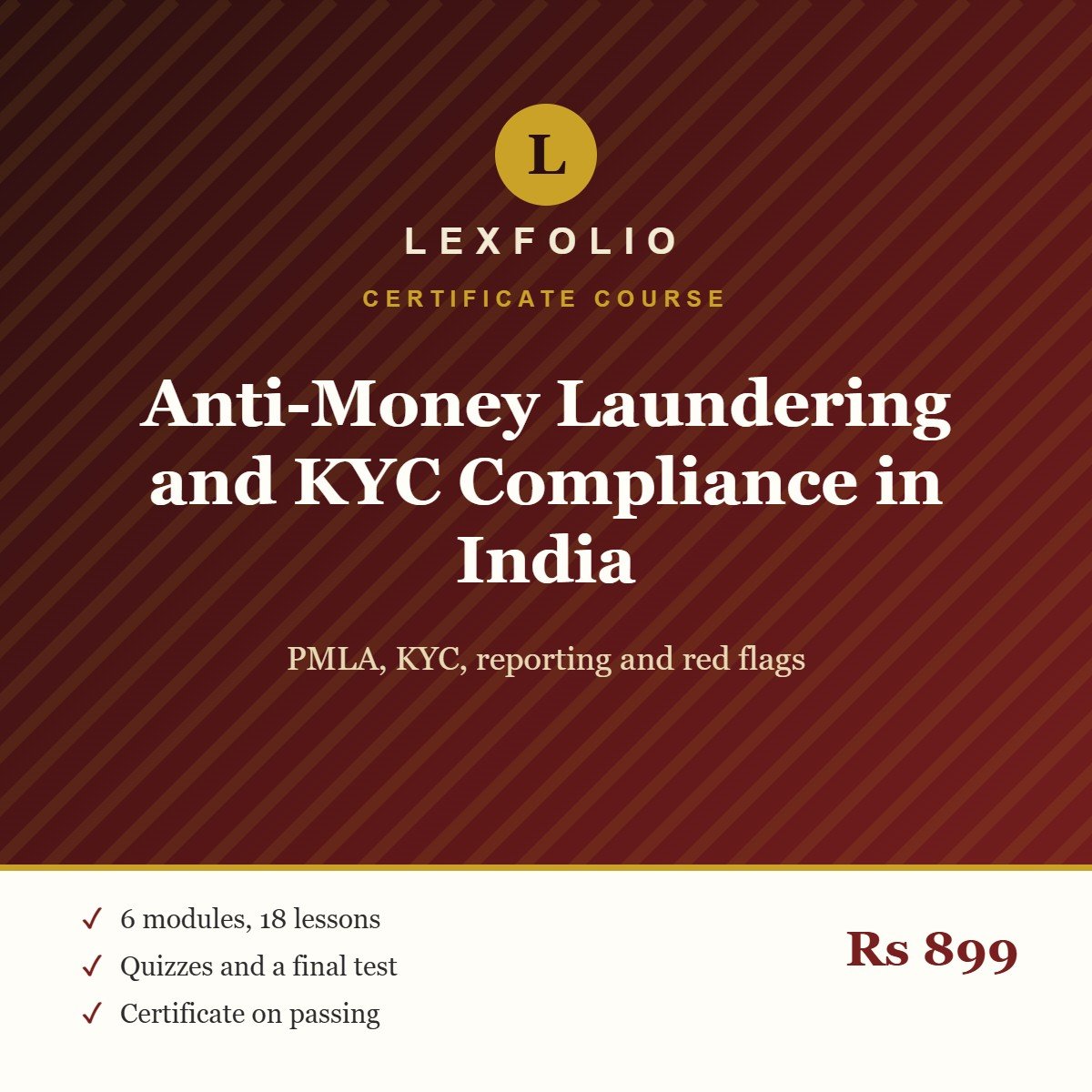
The format is 6 modules, 18 lessons, 6 module quizzes and a 30 question final test, with a pass mark of 60% and 3 attempts. A certificate is issued on passing and is verifiable at lexfolio.in/verify-certificate/. Access is for life, so you can return to the lessons whenever a question comes up at work. Every section number, rule, threshold and timeline is cited so that you can check it against the current text of the Act, the Rules and your own regulator’s direction.
What you will learn
- Explain the offence under section 3, the punishment under section 4 and the reverse burden under section 24
- Work through attachment, search, seizure, arrest and adjudication timelines without looking them up
- Decide whether a business is a reporting entity, including under the 2023 notifications
- Run customer due diligence under rule 9 and build a defensible client file
- Trace beneficial ownership through holding chains and apply the rule 9(3) thresholds
- Pick the correct report type, threshold and timeline for any transaction
- Operate sanctions screening and the section 51A reporting procedure
- Draft an AML policy and a role based training plan for a small or mid sized firm
Who this course is for
- Compliance officers, principal officers and compliance analysts in regulated firms
- Bankers, non banking financial company and payments staff in operations and onboarding
- Chartered accountants, company secretaries, cost accountants and corporate service providers
- Advocates and law students who want a practical grounding in the Act and the Rules
- Job seekers preparing for compliance, risk and financial crime roles
Lexfolio is an independent education platform and is not affiliated with any court, government department or regulator. This course is general legal information, not legal advice.
Access: after payment, open My account > Courses (or the course page) and start learning. Lifetime access to this course.