Description
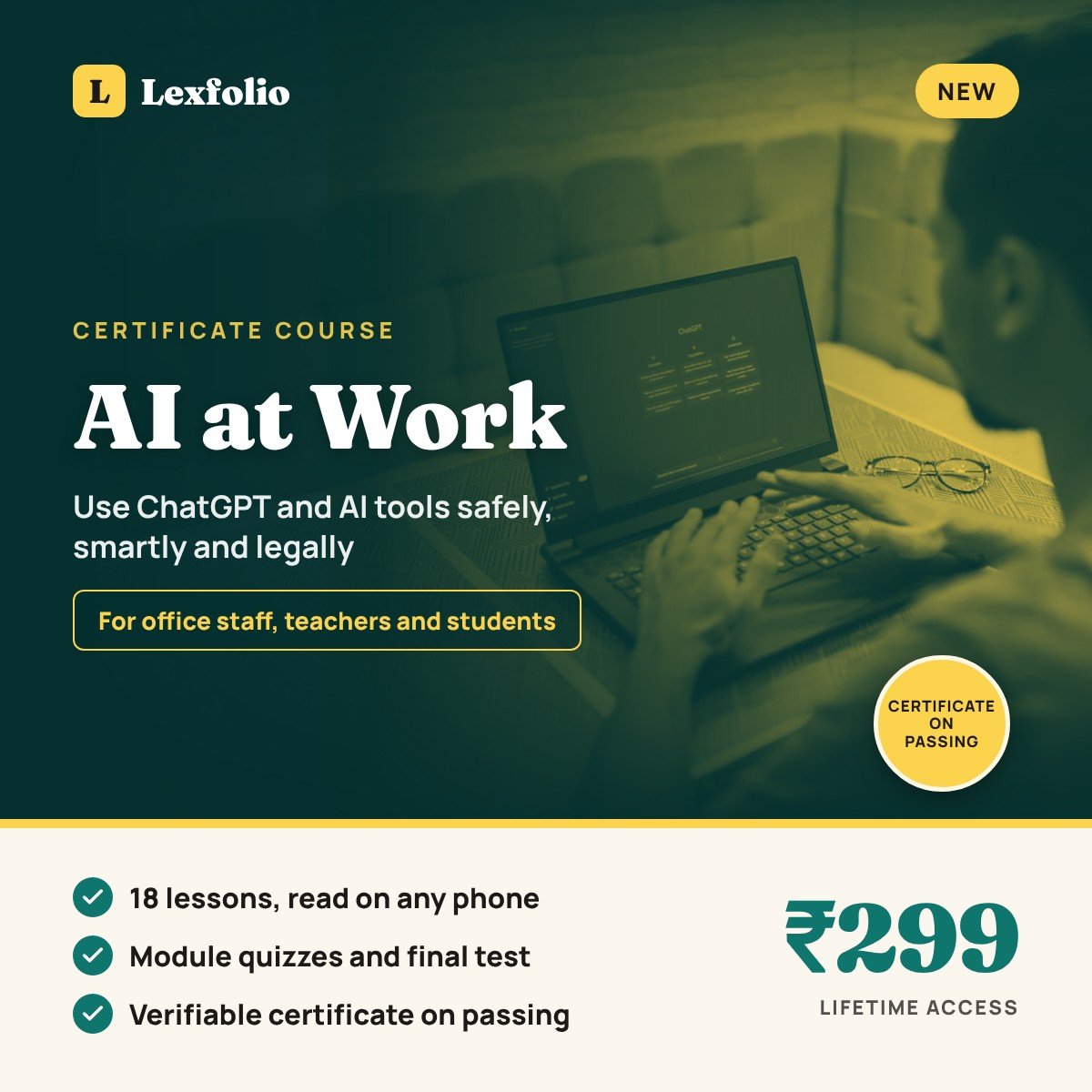
AI tools like ChatGPT, Gemini, Copilot and Claude can save you an hour a day, but almost nobody was taught how to use them safely. Office staff paste client data into free accounts, students submit AI-written work and face misconduct proceedings, job seekers send CVs with achievements the tool invented, businesses publish AI “facts” that turn out to be false, and families lose money to cloned voices and deepfake video calls. This course teaches you to get excellent results from any AI tool while staying accurate, confidential and on the right side of Indian law.
What you will learn
- What generative AI is and is not, and why it sometimes invents facts, figures and references (hallucinations)
- How to write clear prompts for emails, reports, summaries, Excel formulas, presentations, lesson plans and job applications, with worked examples
- A daily verification routine for checking AI output against official and original sources
- What you must never paste into an AI tool, and how employer AI policies work
- How the DPDP Act 2023 and DPDP Rules 2025 apply to AI use, with the phased dates up to 13 May 2027
- Copyright in AI inputs and outputs under the Copyright Act 1957, including the pending ANI v. OpenAI case
- The February 2026 IT Rules on synthetically generated content, deepfake offences under the IT Act and BNS, defamation risk, academic integrity and MeitY’s India AI Governance Guidelines
- How to recognise AI scams, and a practical toolkit: personal checklist, model one-page workplace AI policy and prompt library template
Who this course is for
Office staff in private companies and government offices, school and college teachers, freelancers, small business owners and shopkeepers, college students and job seekers in India. No legal or technical background is needed. If you can type a WhatsApp message, you can follow every lesson.
How the course works
6 modules, 18 lessons, with a quiz of 5 questions after each module. Every lesson uses Indian examples, ends with key takeaways and can be read on a phone. Tools are named only as examples; the course does not rank or recommend any tool, and everything works with any AI assistant. The last module is a practical toolkit with checklists, step-by-step plans and model formats.
How the certificate works
- A final test of 30 multiple-choice questions, mostly real-life situations, with a 45-minute time limit
- Pass mark 60%; you can retry if you do not pass
- On passing, you receive a Lexfolio certificate with a unique ID that anyone can verify online at lexfolio.in/verify-certificate/
- It is a certificate of completion from Lexfolio, not a degree, diploma or professional qualification
This course is for education and general information, not legal advice for a specific case. Law as on 31 October 2026. For your own case, consult a lawyer or your District Legal Services Authority (NALSA helpline 15100).
Access: after payment, open My account > Courses and start learning. Lifetime access.
Access: after payment, open My account > Courses (or the course page) and start learning. Lifetime access to this course.
Free guides for this course
- Is It Legal to Use ChatGPT at Work in India? Rules and Risks
- ChatGPT Prompts for Office Work: Emails, Reports, Excel, HR
- Is It Safe to Put Office Data in ChatGPT? DPDP Act Risks
- Who Owns AI Generated Content in India? Copyright Explained
- AI Policy Template for Companies India: Free Sample Policy
- How to Check if AI Answer Is Correct: Hallucinations Guide