Description
Buying property in India is the largest financial decision most families ever make, and it is made on the basis of documents that very few buyers know how to read. A sale deed is handed over, a tax receipt is produced, a broker says the papers are clear, and money changes hands. Years later a second heir appears, a bank claims a mortgage nobody mentioned, or a municipal notice says the top floor was never sanctioned. Almost every one of these disasters was visible in the records before the money moved.
This course teaches the verification work itself, step by step, in the order a careful buyer or a junior lawyer would actually do it. You will learn what title means in law, how to build and read a chain of title, which of India’s four record systems answers which question, and how to run a search at the sub-registrar’s office rather than waiting for somebody else’s report. You will learn to read an encumbrance certificate and, more importantly, to know what it cannot tell you.
The six modules move from foundations to closing. Module 1 covers title, ownership, possession and the record systems. Module 2 works through the document pack: every kind of transfer instrument, the revenue and municipal records that identify the land, and the planning approvals that decide whether it can lawfully be used. Module 3 is the search module: the registry index search, encumbrance certificates, hidden mortgages and charges, lis pendens, litigation and legal heir checks, public notices and bank legal opinions. Module 4 deals with agricultural land and conversion, inherited and joint family property, and capacity questions involving minors, guardians and powers of attorney. Module 5 covers buying from a builder, with project registration, the agreement for sale, carpet area, allottee remedies and the land and insolvency risks that registration does not cover. Module 6 closes the transaction: the agreement to sell and token money, stamp duty and undervaluation, tax deduction on the purchase, registration mechanics, a red flag table and a complete buyer’s checklist.
Land records, stamp duty and procedure in India are state specific. The course says so throughout, cites central statutes where the law is central, and gives state provisions, such as section 80 of the Uttar Pradesh Revenue Code, 2006, as examples of how such provisions are built rather than as the law everywhere.
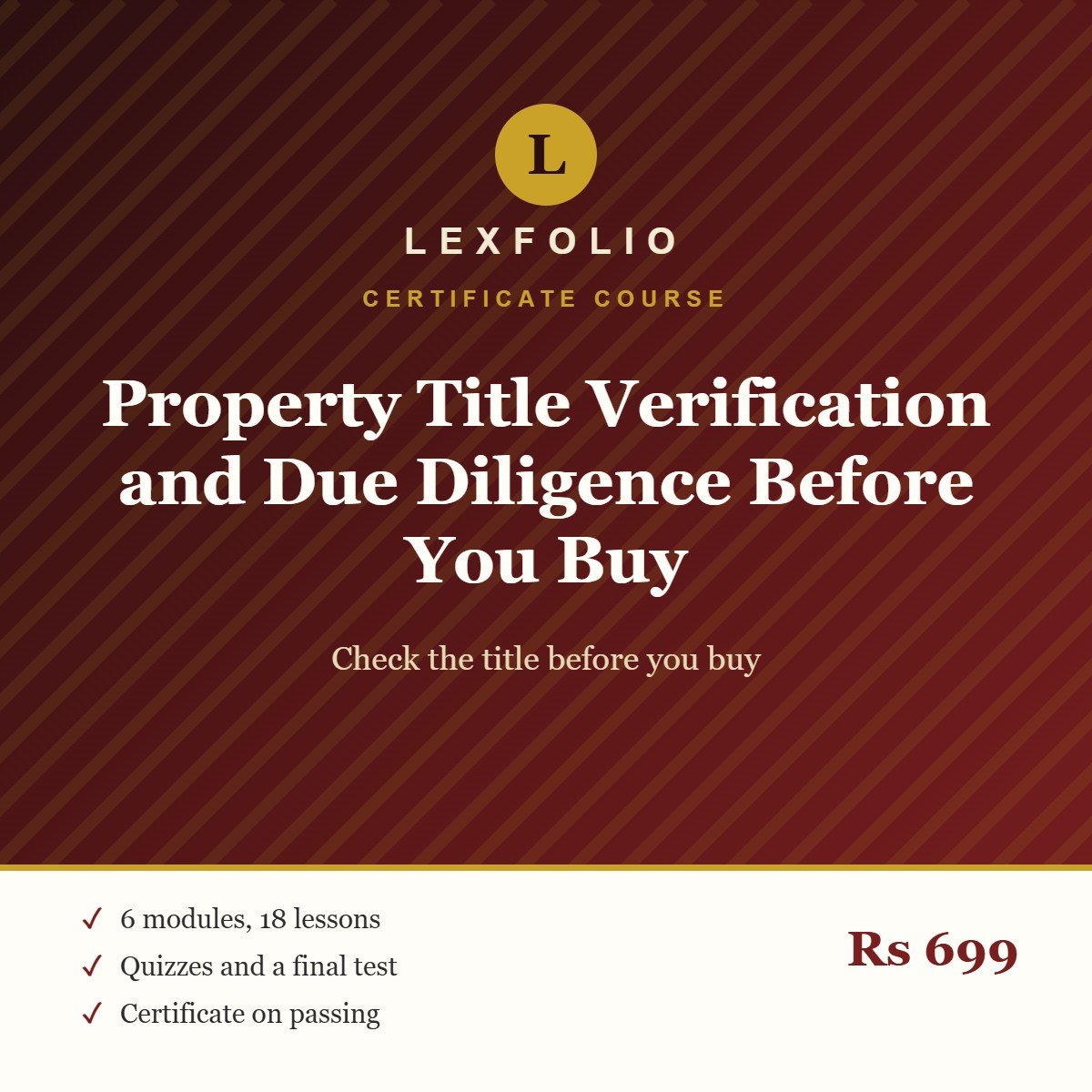
Format: 6 modules, 18 lessons, 6 module quizzes and a 30 question final test. The pass mark is 60%, with 3 attempts. On passing you receive a certificate, verifiable at lexfolio.in/verify-certificate/. You get lifetime access to the course and its updates.
What you will learn
- Distinguish title, ownership and possession, and know what each document can and cannot prove
- Build a thirty year chain of title in a written table and identify every gap in it
- Run an index search at the sub-registry, obtain certified copies, and read an encumbrance certificate with its limits in mind
- Find mortgages, charges, attachments, tenancies and pending litigation that paper alone will not show
- Handle agricultural land, conversion, inherited and joint family property, minors and powers of attorney
- Verify a builder project through its registration file, agreement for sale, carpet area and handover obligations
- Compute stamp duty correctly, comply with tax deduction on the purchase, and register the deed within time
- Apply a red flag table and a three stage due diligence checklist to any purchase
Who this course is for
- Home and plot buyers who want to verify the papers themselves before paying anything
- Small investors buying land, plots or flats in more than one location
- Junior advocates and law students who want practical conveyancing and due diligence skills
- Chartered accountants, bankers and brokers who review property papers for clients
- Non resident buyers relying on family members or attorney holders to complete a purchase
- Anyone who has inherited property and wants to understand what documentation a future sale will need
Lexfolio is an independent education platform and is not affiliated with any court, government department or regulator. This course is general legal information, not legal advice.
Access: after payment, open My account > Courses (or the course page) and start learning. Lifetime access to this course.