About Course
Most couples in India discover marriage law in the wrong order. They marry first, and then find out that the registration office wants a document nobody mentioned, that a bank will not add a spouse without a certificate, or that the thirty day notice under the Special Marriage Act has told a hostile family exactly where they are. This course puts the legal part before the wedding, where it belongs.
It covers what makes a marriage valid under each of the Indian marriage laws, the ceremonies each one requires, the current age of marriage and the status of the proposal to change it, prohibited degrees and sapinda relationships, and what happens when a marriage turns out to be void or voidable. It then deals with registration in detail: the difference between solemnisation and registration, section 8 of the Hindu Marriage Act, state registration requirements, the Special Marriage Act route step by step, the documents and witnesses you will be asked for, and how to register a marriage that took place years ago.
A large part of the course is written for inter-caste and interfaith couples. You will find the constitutional basis of the right to choose a partner, what the Supreme Court actually said in Lata Singh, Shafin Jahan and Shakti Vahini, how the state anti-conversion statutes work including the sixty day declaration in Uttar Pradesh and the pending challenge before the Supreme Court, and a frank comparison of the routes open to a couple who do not want to convert. One module is devoted to safety: what to prepare before you marry, how to make a police complaint that works, the protection petition in the High Court, habeas corpus when an adult is confined, safe houses, and the honest timeline of each remedy.
The last two modules cover relationships the law treats differently. You will learn how courts assess a live-in relationship, the presumption of marriage from long cohabitation, the reliefs available under the Protection of Women from Domestic Violence Act 2005 and the limits on maintenance, the position of children and their inheritance, the live-in registration regime in Uttarakhand and its challenge, bigamy and the second marriage problem, and where same sex couples stand after the Supriyo judgment. The course closes with the paperwork of married life: names and documents, nominations and joint accounts, prenuptial agreements and how Indian courts treat them, dowry and stridhan with the list of presents under the 1985 Rules, and the extra steps for an NRI marriage or a spouse visa.
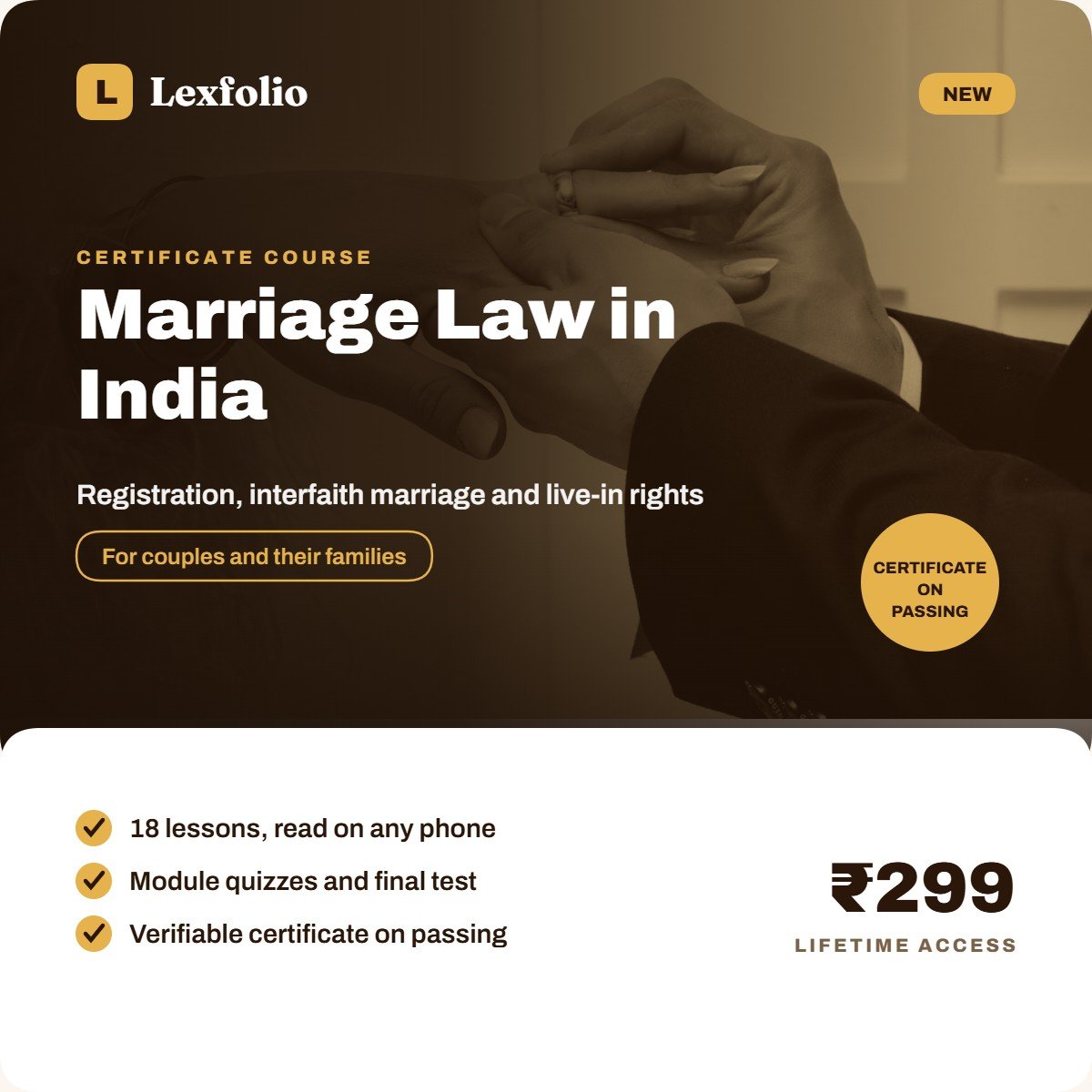
It is written for people who are not lawyers. Every term is explained the first time it appears, worked examples use Indian names and rupee amounts, and the law is stated as it stands in November 2026, with pending matters identified as pending. Six modules, eighteen lessons, a quiz after each module and a final assessment of thirty questions.
Pass the final assessment with 60 per cent or more and you receive a certificate of completion from Lexfolio, carrying a verification link that anyone can check. You get three attempts and lifetime access to the material. The certificate records completion of this course. It is not a government or university qualification, and it is not a licence to practise law.
Course Content
Module 1: What Makes a Marriage Valid
Which Law Will Govern Your Marriage
Age, Consent, Capacity and Prohibited Relationships
Void and Voidable Marriages, and What They Mean for You and Your Children
Module 1 quiz
Module 2: Registration and the Marriage Certificate
Module 3: Inter-caste and Interfaith Marriage
Module 4: Safety, Protection and the Courts
Module 5: Live-in Relationships and Other Arrangements
Module 6: The Paperwork of Married Life
Final Assessment and Certificate
Student Ratings & Reviews

No Review Yet