About Course
Generative AI can draft a legal notice, summarise a judgment or produce written submissions in a minute, and it can also invent judgments, misquote paragraphs and cite repealed sections with complete confidence. Indian courts have now seen this repeatedly: petitions withdrawn in the Delhi High Court, costs imposed by the Bombay High Court, tax assessments quashed, and in July 2026 the Supreme Court setting aside NCLT and NCLAT orders and declaring that citing AI-generated precedents without verification is misconduct by an advocate. This course teaches lawyers and law students to use AI for real speed in research and drafting while keeping verification, confidentiality and professional judgment firmly in human hands.
What you will learn
- How large language models generate text, and why they invent cases, paragraphs and sections
- A safe research workflow and a five-point method to verify every citation on SCC Online, Manupatra, Indian Kanoon, India Code and court websites
- Free official sources for checking statutes and judgments without a paid subscription
- Worked prompts for legal notices, replies, agreements, written submissions, case summaries and chronologies, with a twelve-point review checklist
- Using AI in moot memorials, research papers and internships within competition rules, the UGC plagiarism regulations and chamber confidentiality
- Professional duties under the Advocates Act, 1961 and the BCI Rules, privilege under BSA s.132, client data under the DPDP Act, 2023 and copyright risks
- How Indian courts and tribunals have responded to fake AI citations from 2023 to 2026, Kerala’s AI policy for the district judiciary, the Supreme Court’s draft AI regulations, SUPACE and SUVAS
- A personal AI workflow, a verification checklist, a model engagement-letter clause on AI use and a prompt library for common Indian legal tasks
Who this course is for
Practising advocates, especially in their early years of practice; law students at every stage; LL.M. and Ph.D. researchers; interns, law clerks and research associates; in-house counsel and legal teams. You need basic legal knowledge but no technical background.
How the course works
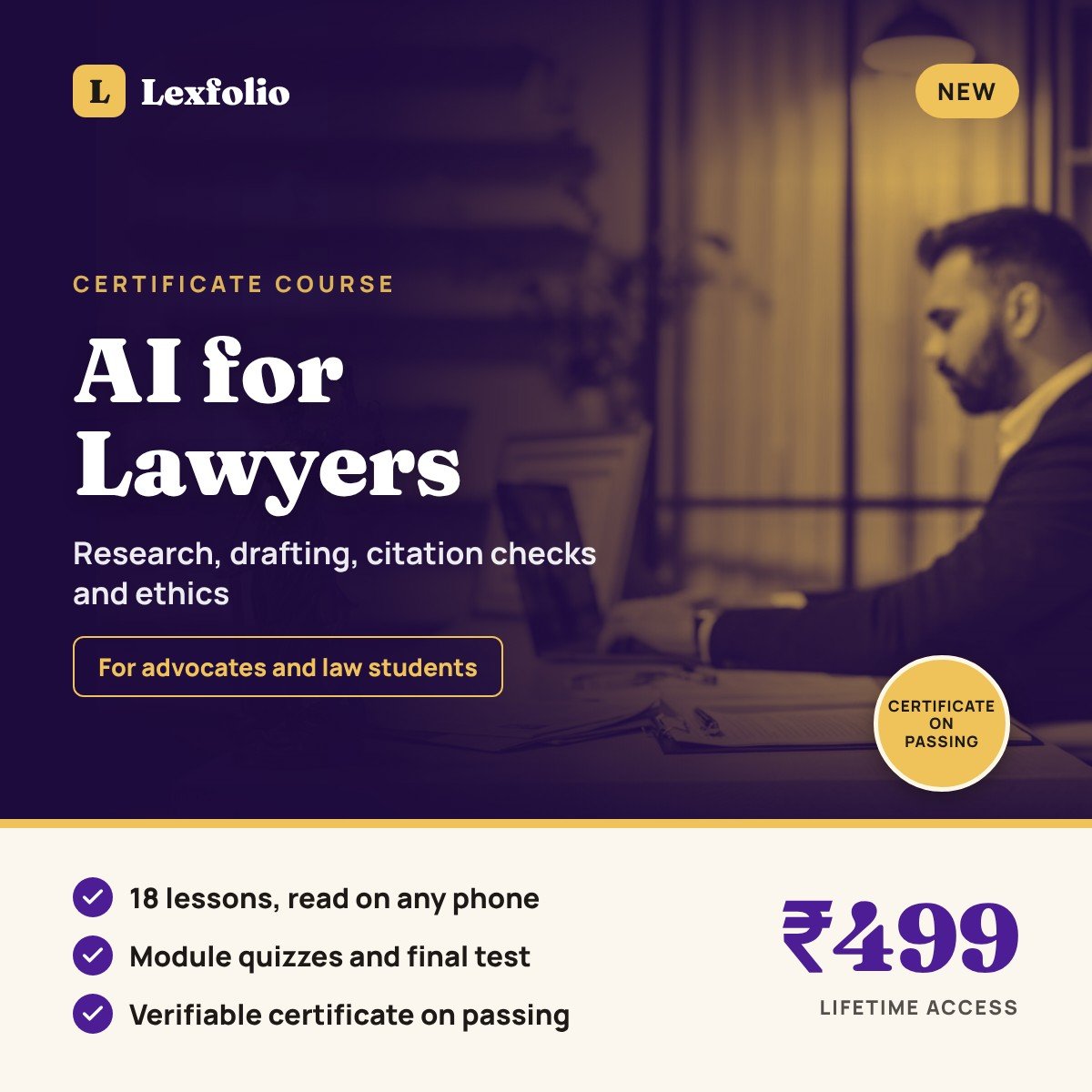
6 modules, 18 lessons, with a quiz of 5 questions after each module. Every lesson uses real Indian situations and reported cases and ends with key takeaways. The last module is a practical toolkit: a safe personal workflow, a one-page verification checklist, a model engagement-letter clause and chamber instruction on AI use, what to do in order when a fake authority is found, and a 20-prompt library.
How the certificate works
- A final test of 30 multiple-choice questions, mostly practical scenarios, with a 45-minute time limit
- Pass mark 60%; you can retry if you do not pass
- On passing, you receive a Lexfolio certificate with a unique ID that anyone can verify online at lexfolio.in/verify-certificate/
- It is a certificate of completion from Lexfolio, not a degree, diploma or professional qualification, and it does not entitle anyone to practise law
This course is for education and general information, not legal advice for a specific case. Law and position as on 31 October 2026. For a specific matter, consult a lawyer or your District Legal Services Authority (NALSA helpline 15100).
Access: after payment, open My account > Courses and start learning. Lifetime access.
Course Content
Module 1: How AI language tools work, and how they fail in legal work
Why AI skills now decide professional reputations
How large language models actually work
How AI fails in legal work: hallucinated cases and sections
Module 1 quiz
Module 2: Legal research with AI, safely
Module 3: Drafting with AI: notices, replies, agreements and submissions
Module 4: Research and writing for law students
Module 5: Ethics, professional duties and how Indian courts are responding
Module 6: A safe personal AI workflow and practical toolkit
Final Assessment and Certificate
Student Ratings & Reviews

No Review Yet