About Course
Artificial intelligence has reached every department faster than any policy: staff paste customer data into chatbots, HR tools rank thousands of applicants overnight, marketing teams publish cloned voices and synthetic videos, lending models decide who reaches a human, and vendors switch on “smart” features with a software update. Each of these engages Indian law today: the DPDP Act and Rules, the IT Act and the 2026 IT Rules on synthetic content, the Copyright Act, consumer law on misleading ads and dark patterns, employment law and sector rules from RBI and SEBI. India has chosen not to pass a single AI law, so the question regulators, clients and courts will ask is simple: did your organisation govern its AI with due care? This course gives managers, compliance officers and founders a clear, practical answer and a ready toolkit.
What you will learn
- Why AI is now a legal and board-level risk, and the roles of developer, deployer, Data Fiduciary and Data Processor
- MeitY’s India AI Governance Guidelines (5 November 2025): the seven sutras, six pillars, AI Governance Group, TPEC and AI Safety Institute, and what industry is expected to do
- How the DPDP Act 2023 and DPDP Rules 2025 apply to AI: phased commencement to 13 May 2027, consent, notice, legitimate uses, accuracy, security, breach intimation, children’s data, Rule 13 and penalties
- The IT Rules as amended in October 2025 and February 2026: synthetic content labelling and provenance, and the 3-hour, 2-hour and 7-day timelines
- Copyright and AI: training, outputs and ownership, ANI v OpenAI in the Delhi High Court and the DPIIT working paper
- Consumer law: misleading AI claims, synthetic endorsements, chatbots and the 13 dark patterns
- Sector rules (RBI’s FREE-AI report, SEBI’s AI responsibility rule), hiring and monitoring risks, and AI vendor contracts and liability
- How to build and run an AI governance programme, with a 90-day plan, a model AI policy, an AI risk register, a vendor checklist and a DPIA-style template; plus a short note on the EU AI Act timeline
Who this course is for
Managers and department heads, compliance and risk officers, company secretaries, HR, marketing and procurement teams, startup founders and product managers, college and university administrators, and MBA and law students who want a practical command of AI law and governance in India. No legal or technical background is needed.
How the course works
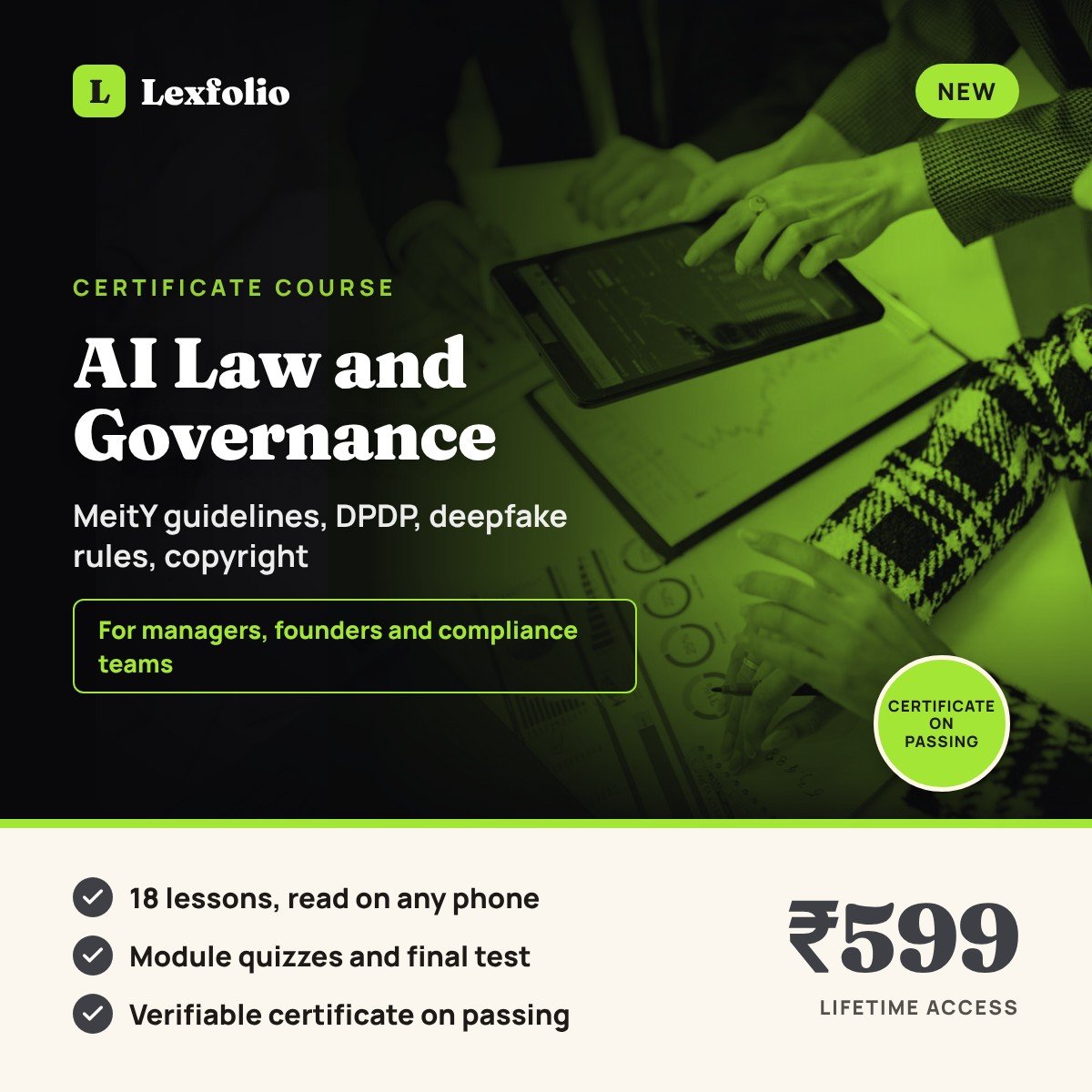
6 modules, 18 lessons, with a quiz of 5 questions after each module. Every lesson works through real workplace situations with Indian examples, explains the law that applies, and ends with key takeaways. The last module is a practical toolkit: a 90-day plan, three checklists, a model AI acceptable use policy, transparency notices, an AI risk register, a vendor due diligence checklist and a DPIA-style impact assessment template.
How the certificate works
- A final test of 30 multiple-choice questions, mostly real-life scenarios, with a 45-minute time limit
- Pass mark 60%; you can retry if you do not pass
- On passing, you receive a Lexfolio certificate with a unique ID that anyone can verify online at lexfolio.in/verify-certificate/
- It is a certificate of completion from Lexfolio, not a degree, diploma or professional qualification
This course is for education and general information, not legal advice for a specific case. Law as on 31 October 2026. For a specific situation, consult a lawyer or your District Legal Services Authority (NALSA helpline 15100).
Access: after payment, open My account > Courses and start learning. Lifetime access.
Course Content
Module 1: Why AI governance matters now, and India’s approach
Lesson 1.1: Why this matters, who this course is for, and how it works
Lesson 1.2: Key concepts: what counts as AI, who is who, and what can go wrong
Lesson 1.3: MeitY’s India AI Governance Guidelines (November 2025)
Module 1 quiz
Module 2: Data protection and AI: the DPDP Act 2023 and DPDP Rules 2025
Module 3: Content, platforms and intellectual property
Module 4: Sector rules, employment risks and contracts with AI vendors
Module 5: Building an AI governance programme
Module 6: The practical toolkit: plan, policy and templates
Final Assessment and Certificate
Student Ratings & Reviews

No Review Yet