About Course
Every week, careful and intelligent people in India lose savings to calls, links and apps that look completely genuine: a “bank officer” who knows their account number, a “CBI officer” on video announcing a “digital arrest”, a part-time job that pays ₹150 before swallowing ₹50,000, a loan app that sends morphed photos to every contact. Most losses happen because people do not know a few simple rules, and do not know what to do in the first hour after the money goes. This course gives your whole family both: the habits that stop scams, and the exact legal steps that give you the best chance of getting money back.
What you will learn
- How the common scams in India work: UPI and QR code tricks, fake KYC, fake customer care, screen-sharing apps, “digital arrest”, parcel, job, investment, loan app, sextortion, SIM swap and deepfake voice scams
- Why your UPI PIN is never needed to receive money, and other rules that stop most frauds
- Phone, account and bank settings: 2FA, app permissions, alerts, limits and a safe account structure
- How to use 1930, cybercrime.gov.in and Sanchar Saathi (Chakshu, lost phone blocking, connections in your name)
- Exactly what to do in the first hour after a fraud, and what evidence to keep
- RBI’s customer liability rules today and the new rules from 1 January 2027, and the RBI Ombudsman under RB-IOS 2026
- How to file an FIR, zero FIR or e-FIR under Section 173 BNSS, and the offences under the BNS and IT Act
- How to protect elderly parents and get fake profiles and intimate images removed within 2 hours
Who this course is for
Families, senior citizens and their grown-up children, homemakers, small business owners who accept digital payments, and college students. No legal or technical background is needed. If you use a smartphone and a UPI app, this course is for you and the people you care about.
How the course works
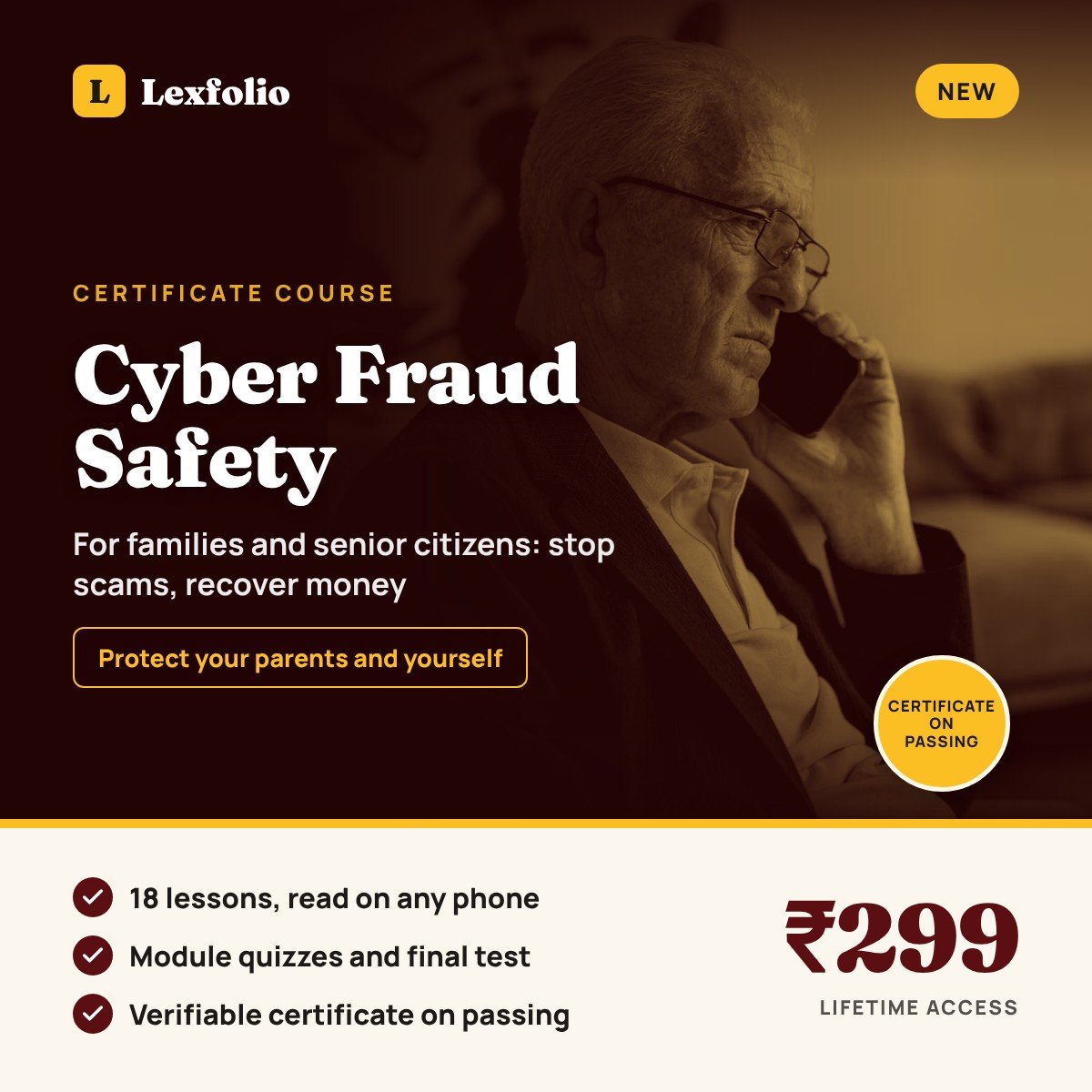
6 modules, 18 lessons, with a quiz of 5 questions after each module. Every lesson uses Indian examples, ends with key takeaways and can be read on a phone. The last module is a practical toolkit with checklists, a step-by-step plan after a fraud, and model formats for complaints to the bank, the police and online platforms.
How the certificate works
- A final test of 30 multiple-choice questions, mostly real-life situations, with a 45-minute time limit
- Pass mark 60%; you can retry if you do not pass
- On passing, you receive a Lexfolio certificate with a unique ID that anyone can verify online at lexfolio.in/verify-certificate/
- It is a certificate of completion from Lexfolio, not a degree, diploma or professional qualification
This course is for education and general information, not legal advice for a specific case. Law as on 29 October 2026. For your own case, consult a lawyer or your District Legal Services Authority (NALSA helpline 15100).
Access: after payment, open My account > Courses and start learning. Lifetime access.
Course Content
Module 1: How cyber fraud works and why families are targeted
Lesson 1.1: Why this course matters and how it works
Lesson 1.2: The scammer’s playbook: fear, urgency, greed and isolation
Lesson 1.3: Payment scams: UPI, QR codes, fake KYC, fake customer care and screen-sharing apps
Module 1 quiz
Module 2: Scams that use fear and impersonation
Module 3: Scams that use greed and need: jobs, investments and loan apps
Module 4: Prevention habits and phone, bank and account settings
Module 5: After a fraud: the first hour, RBI rules, the Ombudsman and the police
Module 6: Protecting your family: a practical toolkit
Final Assessment and Certificate
Student Ratings & Reviews

No Review Yet