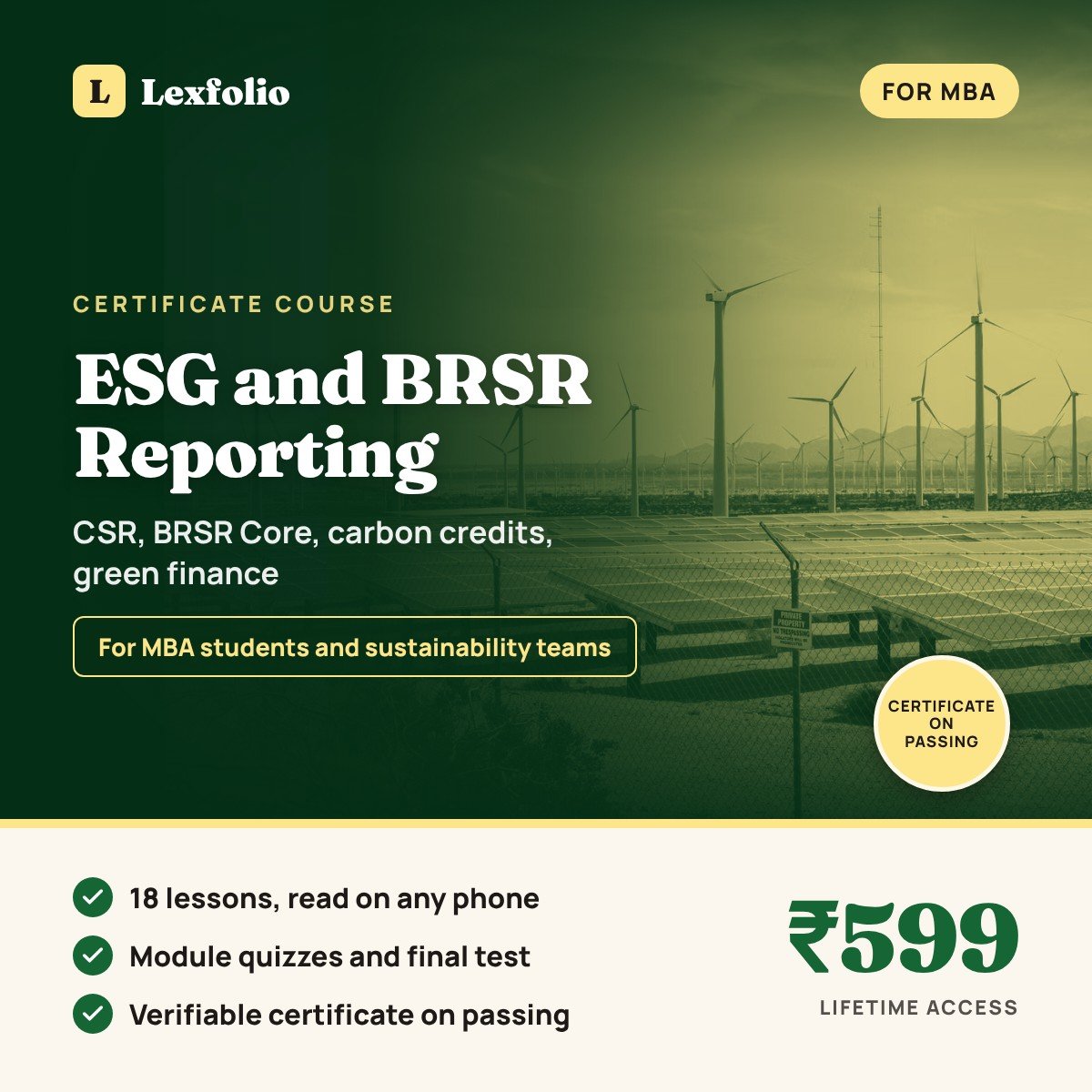
About Course
ESG has moved from the investor presentation into the compliance calendar. Listed companies file a Business Responsibility and Sustainability Report, the largest of them now with independent assessment or assurance of BRSR Core. CSR money left unspent must move to the right account within 30 days or six months, or penalties follow. Cement, aluminium, refinery and textile plants have binding emission intensity targets under the Carbon Credit Trading Scheme. Brands face CCPA guidelines on greenwashing, and suppliers receive ESG questionnaires from every large customer. The people who handle this work are usually managers, consultants and CS trainees, not lawyers. This course gives them a clear, practical command of the Indian law and frameworks behind ESG and BRSR reporting, with templates they can use at work.
What you will learn
- What ESG means, how it differs from CSR, and why investors, lenders and customers ask for it
- CSR under section 135 and Schedule VII of the Companies Act, 2013: thresholds, the 2% rule, the CSR Committee, Form CSR-1 and CSR-2, and the unspent CSR rules and penalties
- ESG in the board’s report under section 134 and directors’ duties under section 166(2)
- The BRSR under SEBI LODR Regulation 34(2)(f), BRSR Core, value chain disclosures and the assessment or assurance glide path after SEBI’s 28 March 2025 changes
- SEBI’s regulation of ESG rating providers, green and ESG debt securities, and RBI’s green deposits framework
- Environment (Protection) Act basics after the Jan Vishwas changes, and EPR for plastic packaging, e-waste and batteries
- The Carbon Credit Trading Scheme, 2023 and the binding emission intensity targets for 2025-26 and 2026-27, the Labour Codes, governance rules and greenwashing risk under the CCPA and ASCI guidelines
- How to run a materiality assessment and ESG data system, with a materiality template, a BRSR data checklist and an ESG policy outline
Who this course is for
MBA and BBA students, sustainability, CSR and EHS executives, management and ESG consultants, company secretaries and CS trainees, finance and investor relations teams, and procurement teams who send or answer supplier ESG questionnaires. No legal background is needed. The international frameworks (GRI, ISSB IFRS S1 and S2, TCFD and the GHG Protocol) are covered as context.
How the course works
6 modules, 18 lessons, with a quiz of 5 questions after each module. Every lesson works through business scenarios set in Indian companies (all company names are invented), explains the law that applies with exact sections, regulations and circulars, and ends with key takeaways. The last module is a practical toolkit: a materiality assessment template, a BRSR data checklist, a model ESG policy outline, a 90-day plan and a yearly “what to do, in order” checklist.
How the certificate works
- A final test of 30 multiple-choice questions, mostly real-life scenarios, with a 45-minute time limit
- Pass mark 60%; you can retry if you do not pass
- On passing, you receive a Lexfolio certificate with a unique ID that anyone can verify online at lexfolio.in/verify-certificate/
- It is a certificate of completion from Lexfolio, not a degree, diploma or professional qualification, and not a registration or accreditation as an assurance provider or ESG rating analyst
How to show this on your CV and LinkedIn
List it under “Certifications” or “Licences and certifications” as “Certificate Course in ESG and BRSR Reporting in India: Law, Frameworks and Practice, Lexfolio (certificate of completion), [month and year]”, and add the certificate ID or verification link so recruiters can check it. In interviews, talk about what you can do: read a BRSR, compute a CSR obligation, explain BRSR Core and the assurance glide path, and run a materiality exercise. Describe it honestly as a certificate of completion, not as a degree or professional qualification.
This course is for education and general information, not legal or investment advice. It does not recommend any security, fund or rating. Law as on 31 October 2026. For a specific situation, consult a lawyer or qualified professional; for free legal aid, contact your District Legal Services Authority (NALSA helpline 15100).
Access: after payment, open My account > Courses and start learning. Lifetime access.
Course Content
Module 1: ESG foundations, why investors and lenders ask, and the legal map
Lesson 1.1: Why this matters, who this course is for, and how it works
Lesson 1.2: What ESG means, and why investors and lenders ask
Lesson 1.3: The Indian legal map, and the global frameworks as context
Module 1 quiz
Module 2: Companies Act: CSR under section 135, Schedule VII and the board’s report
Module 3: SEBI and green finance: BRSR, BRSR Core, ESG ratings, green bonds and green deposits
Module 4: Environment and climate law: EPA basics, EPR and the Carbon Credit Trading Scheme
Module 5: The social and governance pillars, and greenwashing risk
Module 6: Practice: data, materiality, templates and an ESG policy
Final Assessment and Certificate
Student Ratings & Reviews

No Review Yet