About Course
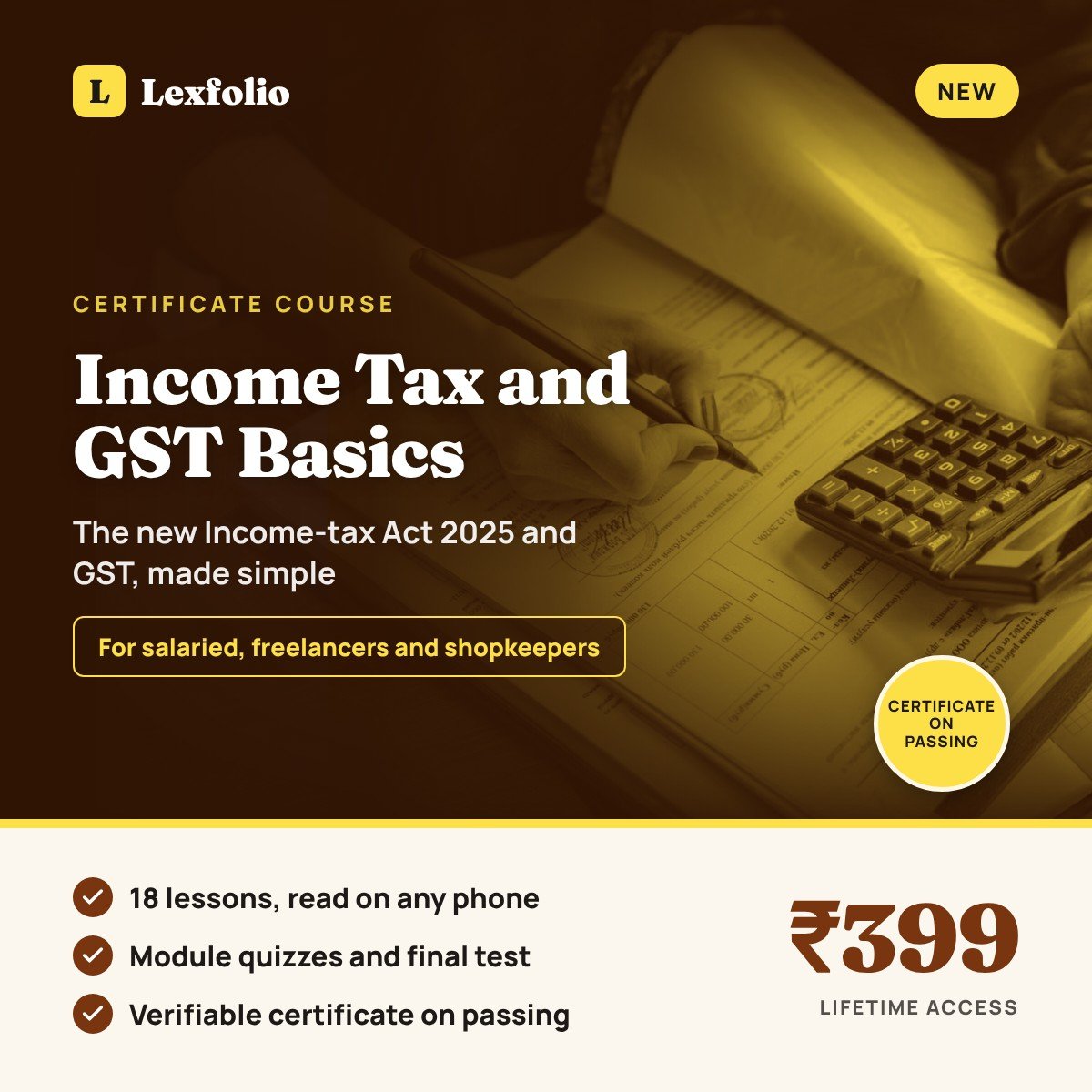
Every earner in India now deals with a tax system that runs on data. Employers, banks, clients, registrars and GST returns report your transactions, and a return that does not match triggers a notice automatically. At the same time the rules have been rewritten: the Income-tax Act, 2025 replaced the 1961 Act from 1 April 2026 with a new “tax year”, new section numbers and new forms (Form 16 is now Form 130, Form 26AS is now Form 168), and GST moved to a 5% and 18% structure from 22 September 2025 with simpler registration from 1 November 2025. This course gives salaried people, freelancers, shopkeepers and small business owners a clear, current command of income-tax and GST basics, so that you file correctly, keep the right records and respond calmly to notices.
What you will learn
- What the Income-tax Act, 2025 changed: the tax year, the new structure and the key new section and form numbers
- Residential status under section 6 and the five heads of income under section 13
- The new regime as default under section 202, slabs for tax year 2026-27, the ₹60,000 rebate and the standard deduction, and when the old regime may suit you
- TDS and TCS under sections 392 to 394: salary, rent, professional fees, contract payments and property purchase, and Budget 2026 changes
- How to reconcile Form 130, Form 131, Form 168 and the AIS before filing
- Due dates after the Finance Act, 2026, belated, revised and updated returns, and presumptive taxation under section 58
- GST basics: registration thresholds, simplified registration, rates after 22 September 2025, composition, invoices and e-invoicing, input tax credit, GSTR-1 and GSTR-3B
- How to verify and respond to income-tax and GST notices, appeal timelines, a compliance calendar, a document checklist and model replies
Who this course is for
Salaried employees and pensioners, freelancers and consultants, shopkeepers and small business owners, and commerce, BBA and MBA students who want a practical, up-to-date understanding of Indian income tax and GST. No accounting or legal background is needed.
How the course works
6 modules, 18 lessons, with a quiz of 5 questions after each module. Every lesson uses everyday Indian examples and worked calculations, explains the rule that applies, and ends with key takeaways. The last module is a practical toolkit: a combined income-tax and GST compliance calendar, document checklists, a plan for the year and model replies to simple notices.
How the certificate works
- A final test of 30 multiple-choice questions, mostly real-life scenarios, with a 45-minute time limit
- Pass mark 60%; you can retry if you do not pass
- On passing, you receive a Lexfolio certificate with a unique ID that anyone can verify online at lexfolio.in/verify-certificate/
- It is a certificate of completion from Lexfolio, not a degree, diploma or professional qualification, and it does not qualify you to practise as a chartered accountant, tax practitioner or GST practitioner
How to show this on your CV and LinkedIn
List it under “Certifications” or “Licences and certifications” as “Certificate Course in the New Income-tax Act 2025 and GST Basics, Lexfolio (certificate of completion)”, with the month of completion and your certificate ID so that employers can verify it at lexfolio.in/verify-certificate/. Describe it honestly as a short self-paced course of completion, not a degree or professional qualification. In interviews, the useful proof is what you can do: explain the new regime, read Form 168 and the AIS, or run a monthly GST routine.
This course is for education and general information, not tax, investment or legal advice for a specific case, and it does not offer tax-planning schemes. Law as on 31 October 2026. For your own return, registration or notice, consult a chartered accountant; for a legal dispute, consult a lawyer or your District Legal Services Authority (NALSA helpline 15100).
Access: after payment, open My account > Courses and start learning. Lifetime access.
Course Content
Module 1: The new Income-tax Act, 2025: what changed and the basic building blocks
Lesson 1.1: Why this matters, who this course is for, and how it works
Lesson 1.2: The Income-tax Act, 2025: tax year, structure and new section numbers
Lesson 1.3: Residential status and the five heads of income
Module 1 quiz
Module 2: Your tax: the new regime, the old regime, slabs, rebate and deductions
Module 3: TDS, TCS and your tax statements
Module 4: Filing returns, presumptive taxation and income-tax notices
Module 5: GST basics: registration, rates, composition, invoicing, input tax credit and returns
Module 6: GST notices and appeals, and your practical compliance toolkit
Final Assessment and Certificate
Student Ratings & Reviews

No Review Yet