About Course
Most family property fights in India start with a missing or badly made paper: no will, an outdated nominee, a gift deed with no condition of care, or a power of attorney that stops working just when it is needed. Elderly parents are left without support, money is paid to the wrong person, and heirs spend years in court. This course explains, in plain language, the rights of senior citizens and the tools of estate planning, so that you can protect yourself or your parents and leave property to the right people.
What you will learn
- How parents and senior citizens can claim maintenance under the 2007 Act (up to ₹10,000 a month) and section 144 BNSS (no ceiling)
- How section 23 lets a parent recover property given on a promise of care, and why abandonment is a crime
- How to make a valid will: capacity, two witnesses under section 63, registration, codicils and revocation
- Where probate stands after the Repealing and Amending Act, 2025
- Why a nominee is usually not the owner, and the new rules for bank, insurance, demat, mutual fund and EPF nominations
- Who inherits without a will under the Hindu Succession Act, with notes on Muslim, Christian and Parsi law
- Gift and settlement deeds, joint accounts, lockers, powers of attorney and planning for incapacity
- How to spot elder abuse and financial fraud, and what to do first, with checklists and model formats
Who this course is for
Senior citizens, their adult sons and daughters, caregivers, and anyone who owns property, savings or investments and wants them to reach the right people without a dispute. No legal background is needed.
How the course works
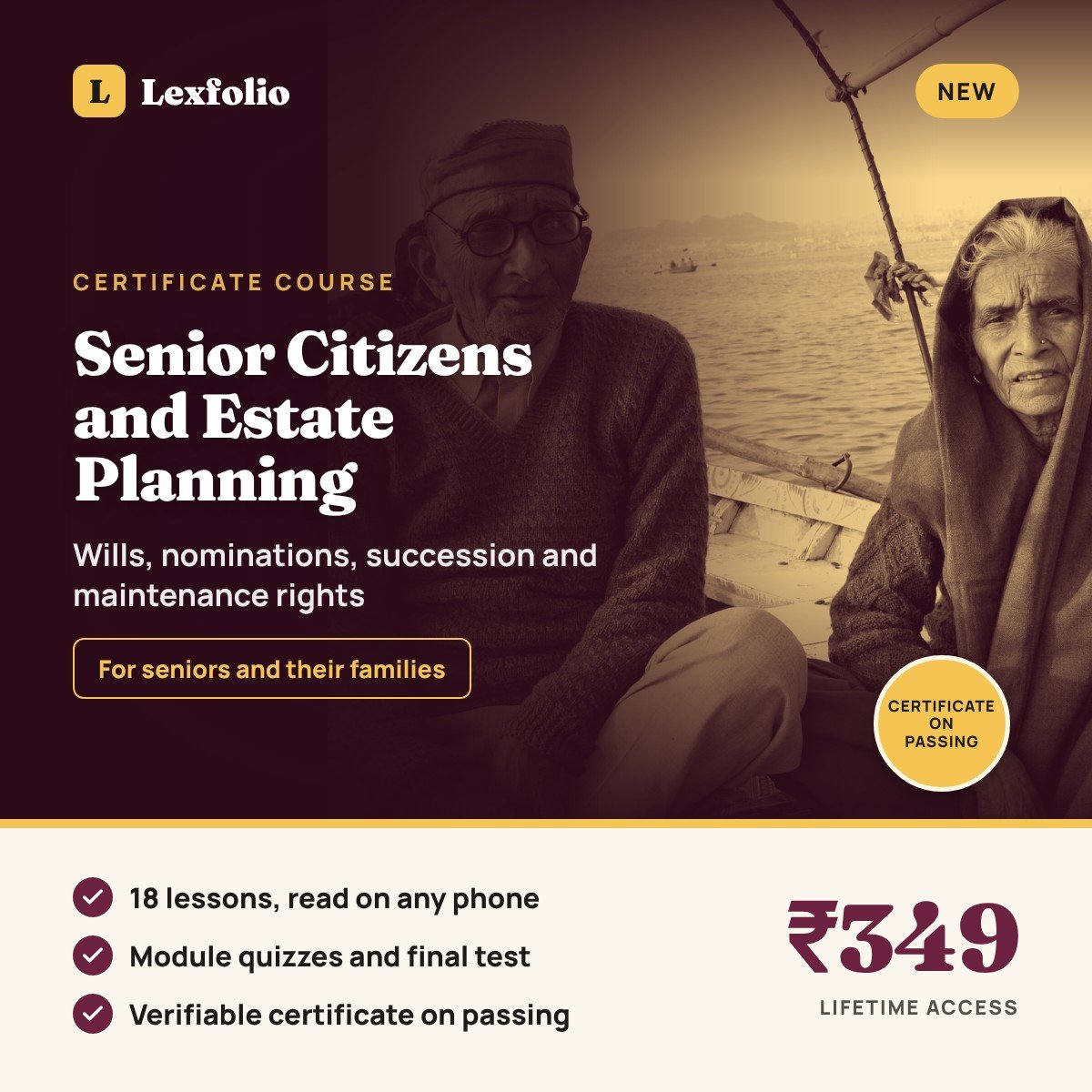
6 modules and 18 self-paced text lessons, each with worked examples from Indian families, exact sections and practical steps. A 5-question quiz follows each module, and the final module gives you checklists and model formats you can adapt.
How the certificate works
- Final test of 30 MCQs, mostly real-life scenarios
- 45 minutes, pass mark 60%
- Retry allowed if you do not pass
- Certificate with a unique ID, verifiable online at lexfolio.in/verify-certificate/
- It is a certificate of completion from Lexfolio, not a degree, diploma or professional qualification
This course is for education and general information, not legal advice for a specific case. Law as on 29 October 2026. For your own matter, consult a lawyer or your District Legal Services Authority (NALSA helpline 15100).
Access: after payment, open My account > Courses and start learning. Lifetime access.
Course Content
Module 1: Senior citizens’ rights and the right to maintenance
Why this course matters, and how it works
Maintenance under the Senior Citizens Act, 2007
Protecting property and person: section 23, section 24 and section 144 BNSS
Module 1 quiz
Module 2: Wills: making, changing and proving them
Module 3: Nominations: banks, insurance, shares, mutual funds and EPF
Module 4: Inheritance without a will
Module 5: Lifetime transfers, powers of attorney and planning for incapacity
Module 6: Elder abuse, financial fraud and your estate planning toolkit
Final Assessment and Certificate
Student Ratings & Reviews

No Review Yet