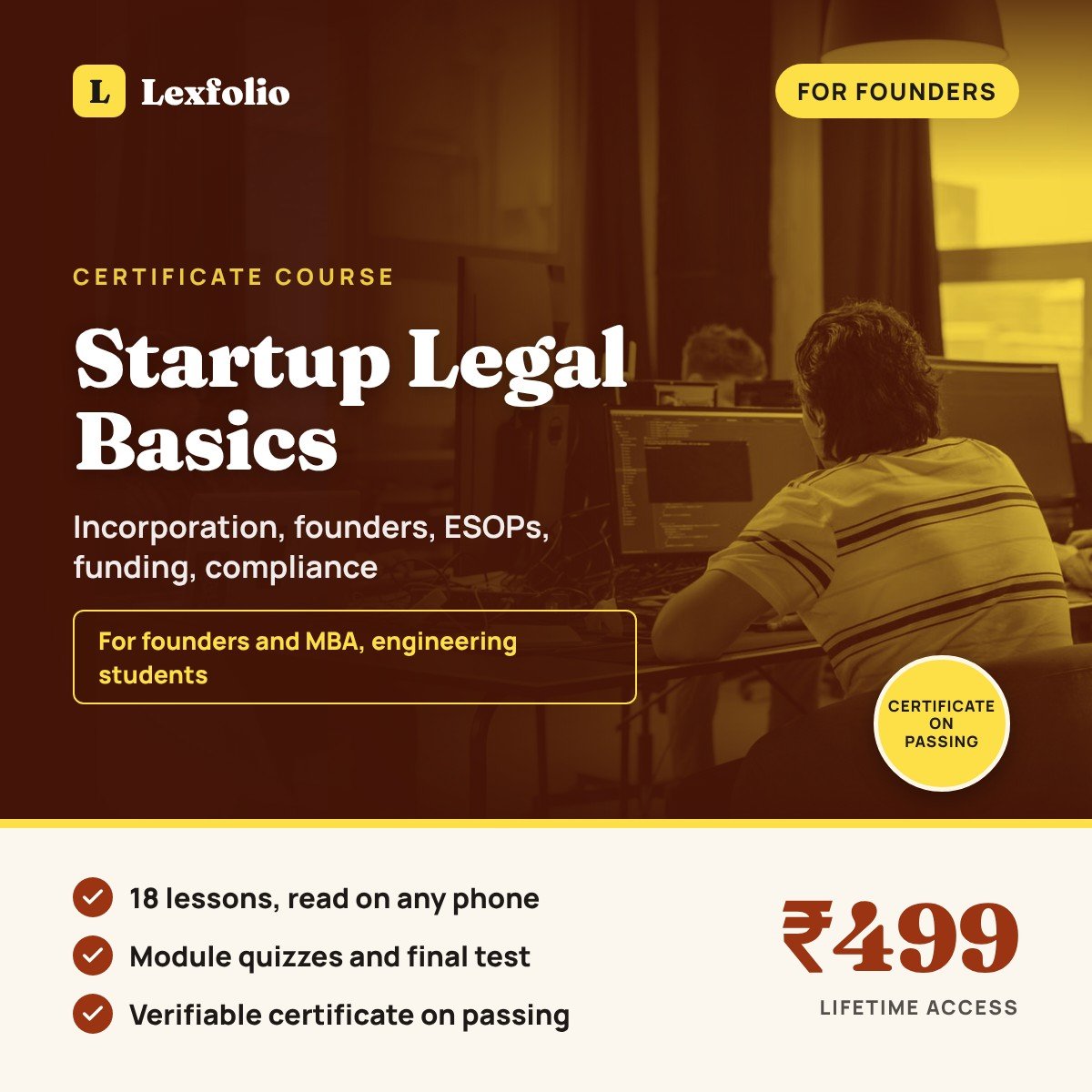
About Course
Most startups that run into legal trouble do not fail in a courtroom. They stall when money is about to arrive: due diligence finds a departed co-founder still holding a third of the shares, code written by a freelancer who never assigned it, ESOPs promised by email without a scheme, a US-style SAFE that Indian law does not recognise as such, foreign money received without FEMA reporting, or two years of missed MCA filings. Every one of these is cheap to prevent and expensive to fix. This course gives founders, MBA and engineering students and startup employees a practical, current command of Indian startup law, from incorporation to funding, with invented Indian company case studies, decision frameworks, checklists and model clause outlines.
What you will learn
- How to choose between a private limited company, LLP and OPC, the small company limits revised on 1 December 2025, and how SPICe+ incorporation and the first 180 days of compliance work (INC-20A, first auditor, share certificates, Rule 9B demat)
- DPIIT recognition under the notification of 4 February 2026 (₹200 crore and 10 years; deep tech ₹300 crore and 20 years), the section 140 tax holiday under the Income-tax Act, 2025, the abolition of angel tax and self-certification
- Founders’ agreements: equity split, reverse vesting, IP assignment under the Copyright Act, non-compete limits under section 27 of the Contract Act, sweat equity and exit
- Shareholders’ agreements and articles: ROFR, tag-along, drag-along, anti-dilution, board seats, reserved matters, liquidation preference and the V.B. Rangaraj rule
- Fundraising instruments: equity, CCPS, CCDs, convertible notes for DPIIT startups and why a US SAFE does not fit as such; private placement steps; FEMA and FDI routes, pricing and reporting (FC-GPR, Form CN, FLA)
- A clause-by-clause term sheet walk-through with worked numbers on valuation, option pools and liquidation preference
- Employment and contractor contracts under the Labour Codes, ESOPs under section 62(1)(b) and Rule 12 and their taxation, and protecting trade marks, code, patents and domain names
- The annual compliance calendar (AOC-4, MGT-7/7A, ADT-1, DIR-3 KYC on its new three-year cycle, GST, TDS, EPF and ESI), DPDP duties and privacy policies, consumer and e-commerce rules for D2C startups, dispute routes, and closing a company by strike off or under the IBC
Who this course is for
Founders and aspiring founders of technology, D2C, deep tech and other scalable ventures; MBA and engineering students who want to start up, join a startup or work in venture capital and consulting; and startup employees who receive ESOPs and sign employment contracts. No legal background is needed. If you run a shop, trading business or local service business, Lexfolio’s course for shopkeepers and small businesses is the better fit.
How the course works
6 modules and 18 self-paced text lessons, with a quiz of 5 questions after each module. Each lesson works through startup scenarios with invented Indian companies, explains the law with exact sections and forms, and ends with key takeaways. The final module is a founder toolkit: a stage-by-stage legal checklist, a month-by-month compliance calendar, a term sheet glossary and model clause outlines with placeholders for reverse vesting, IP assignment, transfer rights, ESOP grant letters, privacy notices and dispute resolution.
How the certificate works
- A final test of 30 multiple-choice questions, mostly startup scenarios, with a 45-minute time limit
- Pass mark 60%; you can retry if you do not pass
- On passing, you receive a Lexfolio certificate with a unique ID that anyone can verify online at lexfolio.in/verify-certificate/
- It is a certificate of completion from Lexfolio, not a degree, diploma or professional qualification, and it does not entitle anyone to practise law or to act as a company secretary or chartered accountant
How to show this on your CV and LinkedIn
List it under “Certifications” or “Licences and certifications” as “Certificate Course in Startup Legal Basics: From Incorporation to Funding, Lexfolio (certificate of completion)”, with the month of completion and your certificate ID so that recruiters and investors can verify it at lexfolio.in/verify-certificate/. Describe it honestly as a short self-paced course of completion, not a degree or professional qualification. In interviews and pitch meetings, the useful proof is what you can do: explain a term sheet, read a cap table, set up a compliance calendar or spot a missing IP assignment.
Access: after payment, open My account > Courses and start learning. Lifetime access.
This course is legal education and general information, not legal, tax or investment advice for a specific venture, and it does not recommend any investment, investor or security. Law as on 31 October 2026. For a specific transaction, filing or dispute, consult a lawyer, chartered accountant or company secretary.
Course Content
Module 1: Choosing a Structure and Incorporating Right
Lesson 1.1: Why startup law matters, who this course is for, and how it works
Lesson 1.2: Private limited company, LLP or OPC: choosing the right vehicle
Lesson 1.3: SPICe+ incorporation and the first 180 days
Module 1 quiz
Module 2: DPIIT Recognition, Founders’ Agreement and Shareholders’ Agreement
Module 3: Raising Money: Instruments, Foreign Investment and the Term Sheet
Module 4: Your Team and Your Assets: Contracts, ESOPs and IP
Module 5: Compliance, Data, Customers, Disputes and Shutting Down
Module 6: Founder Toolkit: Checklist, Calendar, Glossary and Model Clauses
Final Assessment and Certificate
Student Ratings & Reviews

No Review Yet