About Course
A deposit that never comes back. A lock changed overnight. A tenant who stops paying and will not leave. A three-year agreement that turns out to be unenforceable because it was never registered. Most rental disputes in Indian cities start with a missing document or a wrong assumption, and end in months of stress. This course explains, in plain language and with exact sections, what the law says to both tenants and landlords, what to put in writing, and what to do, in order, when something goes wrong.
What you will learn
- The difference between a lease and a leave and licence, and why the label on the document is not decisive
- Which law governs your rental: the Transfer of Property Act, state rent laws, the Model Tenancy Act, 2021, and the changed position in Uttar Pradesh after the Allahabad High Court judgment of 21 August 2026
- What a good rent agreement contains, when registration is compulsory, why 11-month agreements are common, and how stamp duty works
- Police verification of tenants and PG residents, and how to share documents safely
- Deposit caps where adopted, rent increase rules, repairs under Section 108 of the Transfer of Property Act, landlord’s entry and essential utilities
- How a tenancy ends, notice under Section 106, and why forcible eviction and cutting water or electricity are unlawful
- How to recover a deposit, and how landlords recover unpaid rent and deal with a tenant who overstays
- PG and hostel rules, Lok Adalat, free legal aid, and ready-to-adapt model letters and notices
Who this course is for
Tenants in cities (students, working professionals and families), small landlords renting out a flat, a floor or a room, PG and hostel operators, and anyone who handles rental matters for a family member. No legal background is needed. The course treats both sides fairly, so tenants and landlords alike can use it.
How the course works
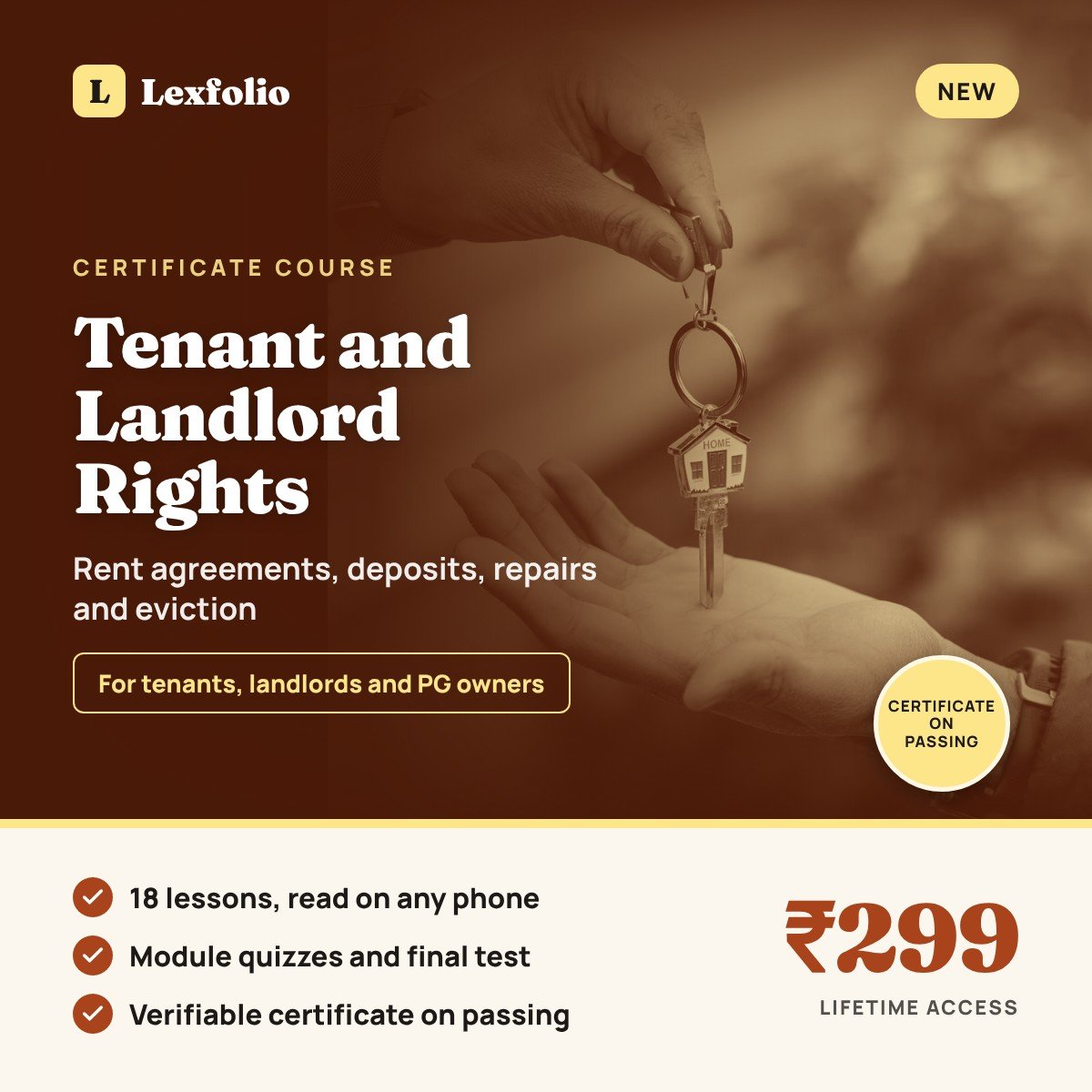
6 modules, 18 self-paced text lessons with worked examples from Indian cities, and a 5-question quiz after each module. The final module gives you checklists, step-by-step plans and model formats you can adapt.
How the certificate works
- Final test of 30 multiple-choice questions, mostly based on real-life situations
- 45 minutes, pass mark 60 percent, retry allowed
- Certificate with a unique ID, verifiable online at lexfolio.in/verify-certificate/
- It is a certificate of completion issued by Lexfolio, not a degree, diploma or professional qualification, and it does not entitle anyone to practise law
Access: after payment, open My account > Courses and start learning. Lifetime access.
This course is for education and general information, not legal advice for a specific case. Tenancy law varies from state to state. Law as on 29 October 2026.
Course Content
Module 1: Foundations: lease, licence and the law that applies
Lesson 1.1: Why every tenant and landlord needs to know this
Lesson 1.2: Lease or leave and licence: why the label matters
Lesson 1.3: Which law applies: TPA, state rent laws, the Model Tenancy Act and Uttar Pradesh
Module 1 quiz
Module 2: The rent agreement: terms, registration, stamp duty and police verification
Module 3: Living in the rented home: deposit, rent, repairs, entry and utilities
Module 4: Ending a tenancy: notice, due process and eviction
Module 5: Money disputes and special arrangements: deposits, unpaid rent, overstaying and PGs
Module 6: Resolving disputes and the practical toolkit
Final Assessment and Certificate
Student Ratings & Reviews

No Review Yet