Description
Governance failures rarely begin in a courtroom. They begin with a related party deal nobody benchmarked, a whistle-blower email nobody investigated, a quarterly number shared before it was announced, an agent’s “success fee” paid to win a government contract, or a risk register that names no owners. Indian law now places detailed duties on companies, boards and officers to prevent these failures, through the Companies Act, 2013, the SEBI LODR and Insider Trading Regulations, the Prevention of Corruption Act and the PMLA, and regulators enforce them through SEBI orders, MCA adjudication and SFIO investigations. This course gives finance and strategy students, consulting aspirants and compliance professionals a structured, current and practical command of corporate governance, compliance and risk management in India, with invented Indian company case studies, decision frameworks and ready templates.
What you will learn
- What corporate governance is, how India’s framework developed from Clause 49 to the Companies Act, 2013 and SEBI LODR, who the regulators are, and the recurring patterns behind governance failures
- Board structure under the Companies Act, 2013: resident, women and independent directors (section 149 and Schedule IV), KMP, the audit committee (section 177), the nomination and remuneration committee (section 178), board meetings, minutes and board evaluation
- Directors’ duties under section 166 in practice, officers in default, personal liability under company, cheque, anti-corruption and securities laws, and D&O insurance
- SEBI LODR Regulations, 2015 for listed companies: board composition, committees, independent directors, secretarial audit after the December 2024 amendments, and continuous disclosure under Regulation 30
- Related party transactions under Regulation 23, including the turnover-based materiality thresholds that took effect in December 2025, ratification, and how Regulation 23 differs from section 188
- Integrity risks: the vigil mechanism under section 177(9), ethics codes and conflicts of interest, insider trading under the SEBI PIT Regulations, 2015 (including the June 2025 UPSI expansion), the corporate bribery offence in section 9 of the Prevention of Corruption Act, and PMLA duties of reporting entities
- Internal financial controls and audit (sections 134(5)(e), 138 and 143, CARO 2020), enterprise risk management with COSO, ISO 31000, the risk register and the Three Lines Model, and compliance management systems
- How regulators enforce (MCA adjudication and compounding, SFIO, NFRA, SEBI orders and settlements), with a compliance calendar template, a board evaluation checklist, a risk register and a whistle-blower policy outline
Who this course is for
MBA students in finance and strategy, consulting aspirants preparing for governance, risk and compliance (GRC) or forensic roles, company secretaries in training, and compliance, risk and internal audit executives who want a practical understanding of corporate governance in India. No law degree is needed; basic familiarity with company structures helps.
How the course works
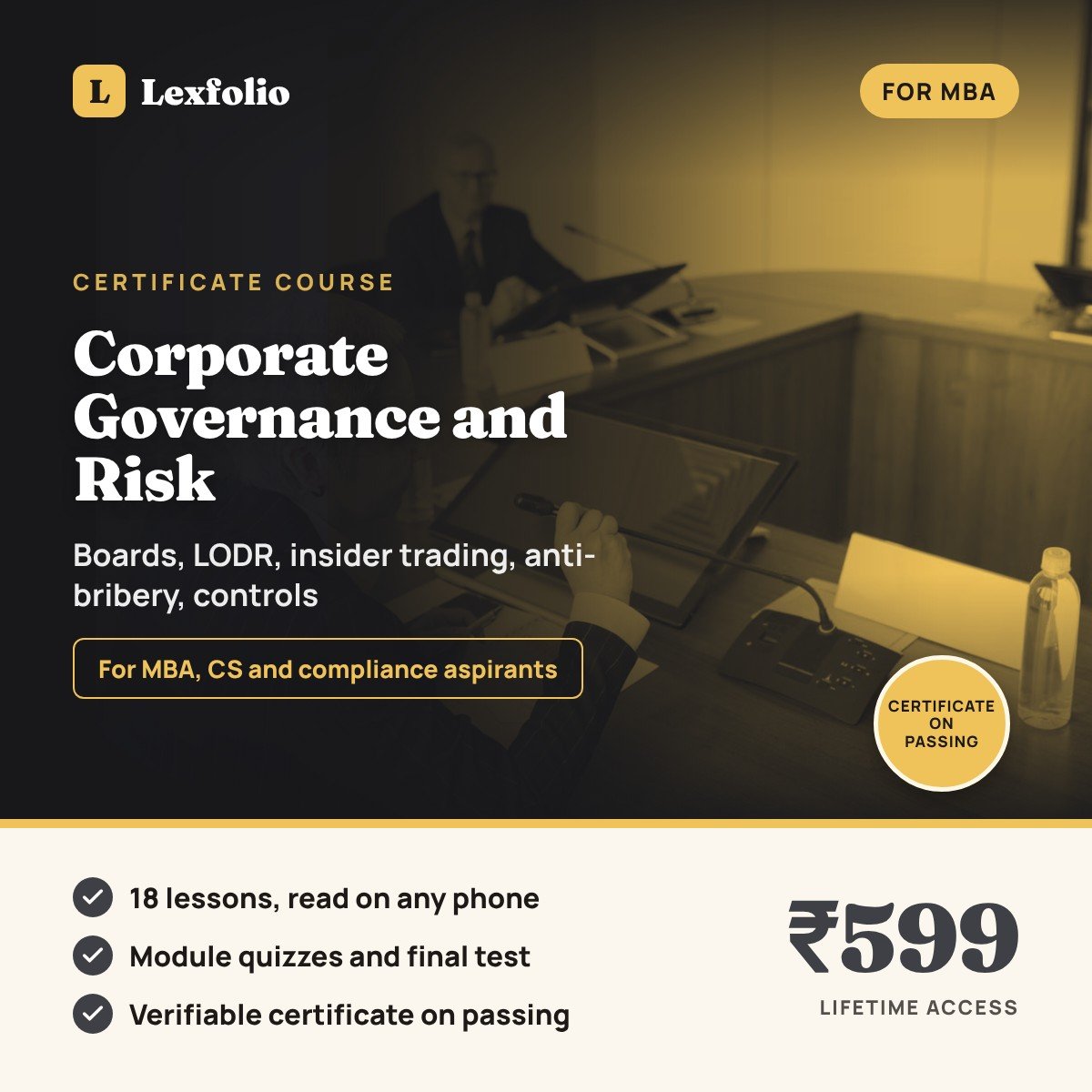
6 modules, 18 lessons, with a quiz of 5 questions after each module. Each lesson works through situations at invented Indian companies, explains the rule with the exact section or regulation, and ends with key takeaways. Real corporate episodes appear only as brief public history. The final module gives a 60-day governance health check plan and four ready templates: a compliance calendar, a board evaluation checklist, a whistle-blower policy outline and a risk register, plus integrated case studies.
How the certificate works
- A final test of 30 multiple-choice questions, mostly real-world scenarios, with a 45-minute time limit
- Pass mark 60%; you can retry if you do not pass
- On passing, you receive a Lexfolio certificate with a unique ID that anyone can verify online at lexfolio.in/verify-certificate/
- It is a certificate of completion from Lexfolio, not a degree, diploma or professional qualification
How to show this on your CV and LinkedIn
List it under “Certifications” or “Licences and certifications” as “Certificate Course in Corporate Governance, Compliance and Risk Management (Certificate of Completion), Lexfolio, [month and year]”, and add the certificate ID or verification link so recruiters can check it. In interviews, talk about what you can do: map a board against section 149 and LODR, test a related party transaction against the Regulation 23 thresholds, build a compliance calendar and a risk register, and explain insider trading and anti-bribery controls. Describe it honestly as a certificate of completion from an online course; it is not a degree, diploma or professional qualification, does not replace the CS, CA or CMA qualifications, and does not entitle anyone to practise law.
This course is for education and general information, not legal advice for a specific case. Law as on 31 October 2026. For a specific situation, consult a qualified professional or lawyer, or your District Legal Services Authority (NALSA helpline 15100).
Access: after payment, open My account > Courses and start learning. Lifetime access.
Access: after payment, open My account > Courses (or the course page) and start learning. Lifetime access to this course.
Free guides for this course
- Corporate Governance Companies Act 2013 Explained
- Independent Director: Role, Duties and Liability in India
- SEBI LODR Compliance Calendar for Listed Companies
- SEBI Insider Trading Rules (PIT Regulations) Explained
- Whistleblower Policy and Vigil Mechanism, Companies Act
- Related Party Transaction Rules in India Explained