Description
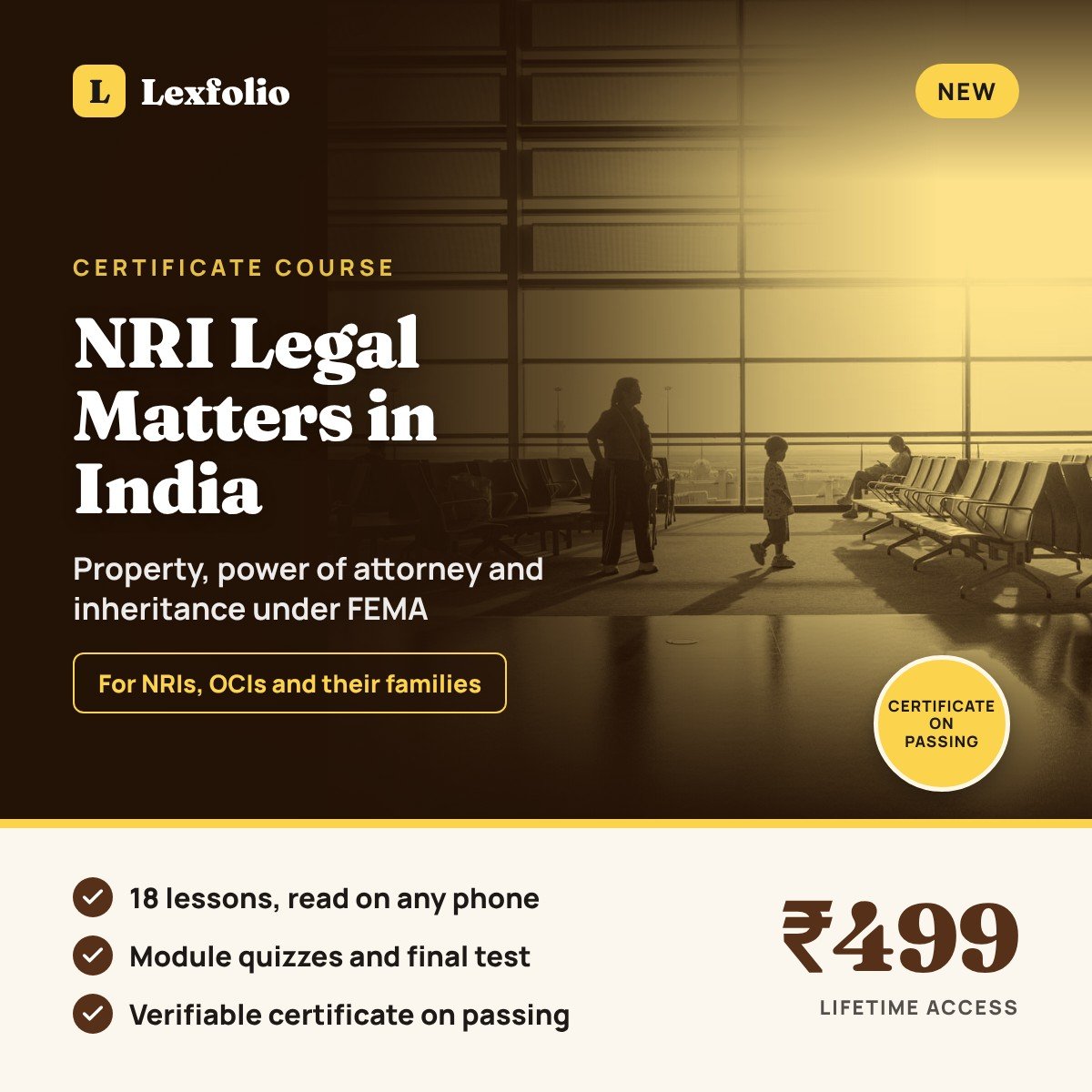
A cousin holding your power of attorney sells your plot. A tenant in your Pune flat stops paying and will not leave. The buyer of your parent’s house withholds a third of the price as tax. The bank refuses to send your sale money abroad because you paid for the flat from the wrong account. These are the everyday problems of Non-Resident Indians and OCI cardholders with property in India, and almost all of them are avoidable. This course explains, in plain English, what the law allows, which documents protect you and what to do, in order, when something goes wrong.
What you will learn
- Who is an NRI and who is an OCI cardholder under FEMA, and how NRE, NRO and FCNR(B) accounts decide what you can pay for and take back
- What NRIs and OCIs may buy, receive as a gift and inherit, and why agricultural land, plantations and farm houses are barred except by inheritance
- How to pay, take a home loan and check title, encumbrances and RERA registration from abroad
- How inheritance works under the Hindu Succession Act and other personal laws, and which papers you need: legal heir certificate, succession certificate, probate after the 2025 omission of section 213, and mutation
- How to make a valid Indian will for Indian assets and coordinate it with a foreign will
- Specific versus general power of attorney, executing one abroad by apostille or at an Indian mission, stamping within three months, registration, revocation and the Suraj Lamp rule on GPA sales
- Letting and selling property, tax deducted by tenants and buyers under the Income-tax Act, 2025, the new PAN-based buyer procedure from 1 October 2026, and repatriation up to USD 1 million a year with Forms 145 and 146
- Fighting encroachment and family disputes from abroad through a POA holder and video-conference evidence, the basics of NRI marriages, and model formats you can adapt
Who this course is for
Non-Resident Indians and OCI cardholders who own, plan to buy or expect to inherit property in India, and their parents, siblings and relatives in India who manage property for them, often as power of attorney holders. No legal background is needed.
How the course works
6 modules and 18 self-paced text lessons, each ending with key takeaways. A 5-question quiz follows each module. Real-life examples with Indian names and cities, checklists, a step-by-step action plan and model formats for a power of attorney, a revocation notice and a letter to a tenant.
How the certificate works
- Final test of 30 multiple choice questions, mostly scenario-based, with a 45-minute time limit
- Pass mark 60%; you can retry if you do not pass
- On passing, you receive a certificate with a unique ID, verifiable online at lexfolio.in/verify-certificate/
- This is a certificate of completion issued by Lexfolio. It is not a degree, diploma or professional qualification, and it does not entitle anyone to practise law.
Access: after payment, open My account > Courses and start learning. Lifetime access.
This course is for education and general information, not legal advice for a specific case. For your own matter, consult a lawyer, a chartered accountant, or the District Legal Services Authority (NALSA helpline 15100). Law as on 29 October 2026.
Access: after payment, open My account > Courses (or the course page) and start learning. Lifetime access to this course.
Free guides for this course
Want everything in one place? Everyday Law for Every Indian covers all areas of daily life. Compare all certificate courses.